Chapter 7 — The Fifth Mark
Arlo did not remember coming back.
He remembered the spring, the smooth stone, and his own face staring at him where no water should have held a reflection. After that, there was the square, people gathered around him, and Sandra demanding his full name.
The name would not come.
That frightened him more than the door of water. A man could lose blood, a weapon, his way, even his courage for a time. A name was something else. It was what the Mountain gave back when someone still belonged.
Arlo remained on his knees, soaked to the waist and coughing up more water than one body could hold. Brina wanted to reach him. Alessandra would not let her.
“He’s breathing.”
“I know.”
“Then let me help.”
“I still don’t know if all of him came back.”
The words struck Brina across the face. Arlo heard them too.
“It’s me.”
His voice came out weak.
Alessandra crouched in front of him. Her Blue Aura did not take the shape of armor. It appeared only as a fine line between her hand and the water spread across the ground.
“Full name.”
Arlo closed his eyes. His mouth trembled.
“Arlo...”
Nothing.
He opened his eyes again, now afraid of himself.
“It won’t come.”
Brina took a step forward. Alessandra raised one hand without looking.
“Brina.”
“He’s from my line.”
“Exactly.”
The door of water behind Arlo remained pinned in place by Sandra’s cut. Not closed. Pinned.
There was no landscape on the other side, only shallow darkness, like the surface of a vessel that was far too deep. Diogo stood before it with the axe on his shoulder, his entire body asking the simplest question in the world: break it or not?
Sandra still would not let him.
The Takenaga remained on the ground under Kauã’s watch, close enough that he could not run and far enough that he could not learn Kauã’s range. He looked less arrogant now that the village had shown it knew how to hold a man without rope.
Wellington watched the hand inside the water.
It did not try to come out.
It waited.
Across its palm were three short marks, one long, and a dot.
“That isn’t a dot,” Davi said.
Marta tried to cover his mouth, too late. Sandra moved only her eyes.
“Then what is it?”
Davi swallowed.
“A place.”
The silence in the square grew more attentive.
“Whose place?” Wellington asked.
The boy clutched Marta’s clothes.
“The fifth one’s.”
Nilo stiffened near the northern exit. Brina looked at the four cultivators from the eastern line, then at Arlo.
Five.
Sandra understood.
“It marked a formation.”
Wellington nodded.
“Three short steps, one long axis, and a return point.”
The Takenaga laughed under his breath. Diogo took the axe off his shoulder.
“You’re getting too comfortable down there.”
The man stopped laughing.
“You think that’s just a mark. It isn’t.”
“Then talk,” Wellington said.
“No.”
Diogo advanced. The prisoner clamped his mouth shut.
Kauã spoke beside him.
“If fear of the axe makes him answer, he might tell us what the door wants him to.”
Diogo breathed through his nose.
“I know.”
“You know, and you’re still going.”
“Sometimes I like to confirm things with my foot.”
“Diogo,” Sandra called.
He stopped. The cost showed in his jaw. Every time Diogo did not strike, something inside him struck on its own.
Sandra indicated the door.
“You hold that.”
“And him?”
“Kauã holds him.”
“Kauã weighs less.”
Without changing expression, Kauã placed the arrowhead behind the Takenaga’s ear.
“Enough.”
The man went still. Diogo smiled.
“Fair.”
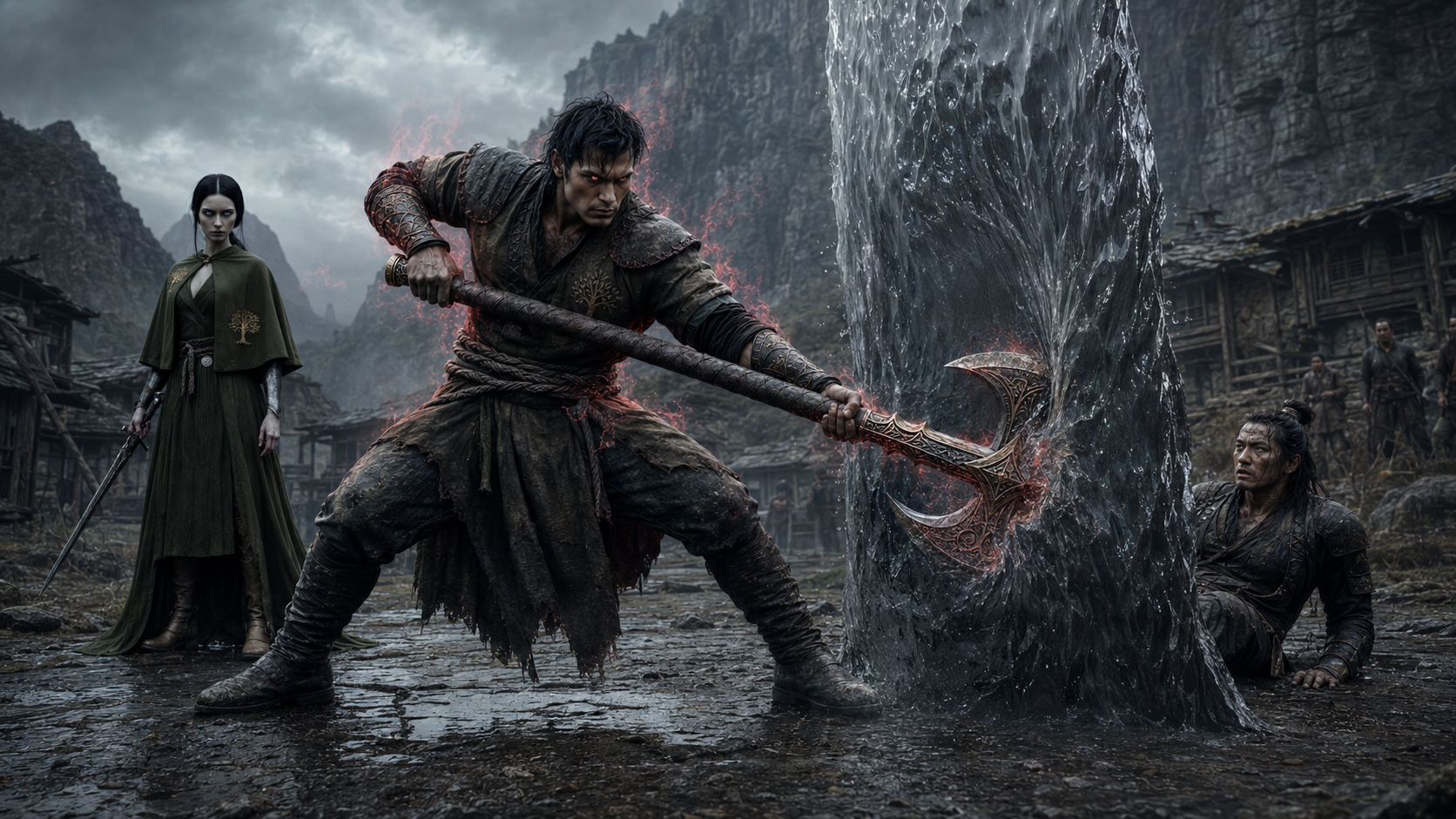
The door opened another finger’s width. Diogo turned and brought the axe down against the ground before it could open farther.
It was not a blow.
It was a boundary.
The impact traveled through the square under their feet. The water drew back a little.
Wellington noticed.
“It responds to mass.”
Diogo did not look away.
“It has good taste.”
“That isn’t brute force.”
“Neither am I.”
Diogo had planted the axe exactly where the water was trying to become a passage. The earth beneath the blade did not crack; it sank half a finger’s width and locked. Behind the iron, his body became a pillar.
Sandra began assigning the village.
“Children behind the fountain. Marta with them. Joel, ledger shut and tied down. Heren, hinge and storehouse. Nilo, north. Brina, east. Two cultivators with each of you. No one goes alone, and no one comes back by a path they didn’t use to leave.”
Nilo asked:
“And if they come back?”
“They stop before the square.”
“And if they don’t stop?”
Sandra looked at the door.
“Then less of them came back than left.”
Nilo accepted that without liking it.
Wellington went to Arlo. His rib still bit, but biting was not an order.
Alessandra saw him coming.
“Slowly.”
“I’m always gentle.”
“With stone, maybe.”
He knelt in front of Arlo and kept the Rose Aura close to his skin.
“You saw your face in the stone. And behind you, there was another you.”
“No.”
Wellington waited. Arlo trembled.
“Behind me was someone wearing my fear.”
Brina closed her hand.
“What do you mean?”
“I looked into the stone and saw that I would come back without you. I saw the square watching me, Sandra asking for my name, and me unable to answer.”
Understanding entered Wellington cold.
“The spring showed you first.”
Arlo nodded.
“Then it called.”
“In whose voice?”
He looked at Brina.
“Hers.”
Brina went pale.
“I didn’t call you.”
“I know.”
The water on the ground went tak. Alessandra pressed down with the blue line.
“Don’t answer guilt.”
Brina clenched her teeth.
“He heard my voice.”
“And guilt wants you to step where the voice called from.”
Brina stayed where she was. That saved her foot. A thread of water darted through the exact place she would have occupied.
Diogo caught it from the corner of his eye.
“Clever.”
“Too clever,” Wellington replied.
At the storehouse, Heren wedged the door open with two blocks and an iron bar. The hinge was still giving off heat, pulsing like a metal heart.
Joel gripped the ledger in both hands.
“I need to take this somewhere far away.”
Heren looked at him.
“Where’s far away?”
Joel opened his mouth, then gave up. There was no far away anymore.
The smith wrapped a leather strap around the ledger.
“Then tie it down here.”
“It’s a book, not an animal.”
“Yesterday a sack wanted to be an owner. Today a book wants to walk. Keep up with your profession.”
Joel had no answer.
The corner of the page for the Two Hundred Fund was wet even though the ledger remained closed. The water did not run; it seeped through the cover as if it knew exactly where to go.
Alessandra saw it from across the square.
“Joel. Who is in the Fund today?”
He froze. Sandra turned.
“Answer.”
“Children, elders, three people injured while gathering, two with no close family, the emergency salt stores, the winter grain, and the tools kept out of common use.”
“People,” Alessandra said.
“And the things that keep people alive.”
The door of water trembled. Diogo leaned harder into the axe.
“It heard.”
Wellington looked at Joel.
“No more lists out loud.”
The man flushed.
“I only answered.”
“I know.”
“Then why does that sound like a scolding?”
“Because the Mountain likes it when we explain too much.”
Joel closed his mouth.
Kauã crouched beside the Takenaga.
“Name.”
“Riku.”
“Full.”
The man smiled through bloody teeth.
“Want to test whether I’m really me?”
Kauã brought the arrowhead closer.
Riku breathed.
“Riku Takenaga.”
Nothing happened.
Kauã tilted his head.
“His full name is still his.”
Sandra heard him.
“Then he still answers for what he did.”
Riku looked at her.
“I did nothing to you.”
Diogo laughed, and the door drew back a little at the sound.
“You tried to cut Kauã.”
“He was between me and the way out.”
“You keep making it worse.”
Riku turned his face toward the ground.
“I was in the south with five men. The trail opened. We thought it was a new passage.”
Wellington asked:
“Who thought that?”
Riku did not answer.
“He did,” Kauã said.
The prisoner closed his eyes.
“Yes.”
“Why?”
“Because I know the Blind Bamboo Grove.”
Sandra approached, and the square made room for her.
“You know false trails. You don’t know the Mountain.”
Riku glared at her.
“Every Oliveira talks as if the world outside this place were a child.”
Another finger’s width of Sandra’s blade came free.
“And every intruder talks as if getting lost gave them the right to enter.”
Riku fell silent out of anger, not fear. Wellington noticed the difference.
“Who paid you?”
“What?”
“To come up here.”
“No one.”
Kauã pressed the arrowhead closer.
“Thin lie.”
Riku spat to the side.
“Not to come up. To map the border.”
“Who?” Sandra asked.
Riku smiled again.
“That answer costs.”
Diogo put more weight on the axe. The door gave a low sound, annoyed at being ignored.
“I can pay in teeth.”
Riku studied not the weapon, but the way Diogo held the passage in place without needing to watch it every second.
“You’re more than strength.”
Diogo bared his teeth.
“And you’re not as clever as you want to be.”
“If you were only strength, you would’ve struck already.”
“I’m busy.”
The door advanced. Without raising the blade, Diogo twisted the axe and changed its angle. The water struck the blind side of the iron and lost its shape.
A blow without a blow.
Wellington saw it. So did Alessandra. Riku saw it best, and his expression changed.
“You’re making it push wrong.”
Diogo looked at him.
“Keep talking.”
Riku realized too late that he had answered like a fighter. Kauã and Sandra realized at the same time.
“You fight by controlling routes.”
Riku went quiet.
Diogo turned the axe a little farther. The door tried to slip around the right; he stepped there first. The water withdrew.
Diogo was forcing a bodiless passage to choose bad directions. Riku began to reconsider the threat in front of him.
“You’d fight well against people.”
“I fight better against people who talk too much.”
The door closed another finger’s width, not in defeat, but in interest.
Sandra did not like that.
“Diogo, switch.”
“No.”
“That wasn’t a request.”
“I know. But if I move now, it learns the hole I leave behind.”
Sandra went still. Wellington did not interfere, because Diogo was right. The door had stopped searching for an opening. Now it was measuring how much of that space belonged to his body.
Sandra accepted it with a small gesture.
“Then don’t give it the same weight twice.”
Diogo adjusted his footing just enough to make the water tremble.
Far from the square, Nilo had returned to the Watchers’ Escarpment with two cultivators. Without him, the square felt smaller.
The Mountain felt larger.
The third marker had turned again. This time, the mark pointed down—not inward or outward, but toward something beneath the trail.
Brás was too quiet.
“Talk,” Nilo said.
“You’ll say I’m hearing things.”
“Then say it quietly.”
Brás stared at the marker.
“There are people walking underneath us.”
Cíntia crouched and put her ear to the stone. Three breaths later, she rose quickly.
“Those aren’t people.”
“What are they?”
“Footsteps trying to become people.”
Nilo hated the sentence because he understood it.
Beneath the escarpment, something struck at imperfect intervals.
Tak. Tak. Drag. Tak.
A long pause.
Tak.
It was learning the patrol’s rhythm.
Nilo marked the stone with a sliver of bamboo. One horizontal cut: north.
The stone accepted it for an instant. Then the mark darkened and grew another short stroke beside it.
Nilo stepped back.
“We’re going back.”
Brás tightened his grip on the spear.
“Again?”
“Alive again.”
Cíntia pointed to the trail.
“What if it shortens the way?”
Nilo looked at the path.
“Then we don’t use a path.”
They returned over bare rock: slowly, awkwardly, the hard way. That was exactly why the Mountain took longer to answer.
In the east, Brina led two cultivators to the first clear spring. The water that should have run down the wall clung to the stone like transparent skin.
Brina saw five faces in it: her own, Arlo’s, those of her two companions, and a fifth man who did not belong to the team. He had narrow eyes, a short beard, and a thin mouth.
An outsider’s face.
He smiled from within the stone. Brina raised her knife.
“Don’t look.”
The two behind her looked anyway.
The face opened its mouth. No voice emerged, only five bubbles. Four burst in silence. The fifth turned to blood.
Brina cut her palm and smeared blood across the stone’s eye. It was not a pretty technique. It was patrol work. If something wanted a face, she would give it dirt.
The water shivered. Before disappearing, the fifth face left a word traced in the vapor.
Mizu.
Brina did not know whether it was a name, a clan, or bait. She knew it was evidence.
In the west, Kauã found the second mark before anyone called him. It was high on a tree, facing into the bark: three short strokes, one long, a dot, and a line drawn through them.
The same as the hinge.
Motionless on the branch, Kauã watched two patrolmen search for tracks where there were far too many.
That was new. Until then, the thing had cleaned paths. Here, it had strewn bootprints and animal tracks, rope drags and knee marks across the earth—a whole fight poured onto the ground without a single body.
Kauã drew an arrow and aimed not at the tracks, but at the empty space beside them.
“Show yourself.”
Nothing answered. A leaf fell in the wind and stopped in midair for half a second.
Kauã shot.
The arrow pierced the leaf and struck something invisible.
Tak.
The air burst. A silhouette retreated among the trees, neither entirely human nor entirely beast, though it wore a man’s height.
Kauã did not pursue. He fired another arrow into its escape route—not to hit it, but to mark it. The arrowhead buried itself in a trunk, and a small burst of Aura shook the bark. The silhouette had to change direction.
Kauã smiled without humor.
“Now you get to dodge too.”
Back in the square, Sandra received all three signals almost at once: a short whistle from the north, a strip of blue cloth in the east, and a small detonation in the west.
She closed her hand.
“Three fronts confirmed.”
Still clutching the bound ledger, Joel asked:
“Is that good or bad?”
Heren answered:
“Confirmed is rarely good.”
The door of water closed another finger’s width. Diogo was sweating—not from simple exertion, but from containment. The axe was beginning to darken near the grip.
Wellington noticed.
“Load?”
Diogo did not answer. Riku answered for him.
“Not much. Enough to break an ordinary man’s rib without quite touching him.”
Diogo looked at the Takenaga.
“You know this?”
“I know men who pretend to be walls. You’re not pretending.”
“And you know men who use the forest as an excuse to run.”
Riku smiled.
“I do. I was the best.”
The door suddenly opened not forward, but down. The water sank into the ground and dragged at the axe.
Diogo felt it before he lost the weapon. Instead of pulling back, he drove it deeper.
Everyone shouted:
“Diogo!”
He put his weight into it, only one step. The ground trembled, and the blade sank halfway in.
The door tried to swallow it. Diogo allowed it for a fraction, then twisted the handle. The water bent, and the opening lost its shape.
It did not close.
It folded.
Wellington understood the risk.
“He’s using its bite as a lock.”
Sandra understood too.
“Diogo, get out before it learns.”
“Not yet.”
The axe darkened farther. A charge climbed the iron like an ember without flame.
Diogo took two breaths. The water pulled, and he gave it another finger’s width. Then he released the grip with his left hand and struck his fist against his own chest.
It was not a ritual.
It was rhythm.
His body answered. A Red Aura appeared low, dirty with heat, held tight around his shoulders and the axe.
The door recoiled, struck through the very force it had used to pull.
Riku’s smile disappeared.
“Forge of Wrath.”
Diogo turned his head slowly.
“You talk too much for a man on the ground.”
“And you use too much power for a man who claims he’s only holding a door.”
Diogo pulled the axe free. The water could no longer keep it. The blade came out with a dry sound.
Tak.
Half the door broke apart. The other half became a thin stream and raced toward Arlo.
Alessandra was already there. Her blue line stopped the water before it reached his chest.
On impact, the stream showed a reflection. Not Arlo, but the same man Brina had seen in the spring: thin mouth, short beard, cold eyes.
Alessandra saw him. Wellington saw him reflected in her Aura. Sandra saw him in both their faces.
“Who?”
Brina reached the square at that moment, out of breath.
“There’s a name in the east.”
Sandra kept her eyes on the water.
“Say it.”
“Mizu.”
Riku closed his eyes.
Kauã appeared on the storehouse roof.
“Invisible presence in the west. Marked, not trapped.”
Nilo entered through the northern exit.
“Footsteps underneath the north.”
The square seemed to shrink under the sheer number of things trying to enter at once.
Wellington pointed at Riku.
“He knows Mizu.”
Diogo went to the Takenaga. This time, Sandra did not stop him.
Riku opened his eyes.
“I know the name.”
“Full,” Sandra ordered.
He drew a deep breath.
“Mizuhara.”
Brina tightened her grip on the knife.
“Clan Mizuhara?”
“East. Barriers. Flow. Containment.”
Alessandra looked at the water caught in her Aura.
“Then it isn’t only the south.”
“It was never only the south,” Riku replied.
Diogo crouched in front of him, close enough that he did not need to raise his voice.
“Now you’re going to tell us who else is on this border.”
“And if I don’t?”
Diogo smiled, low and ugly.
“Then I find out whether you fight better on your feet than you talk on the ground.”
Riku answered with a smile of genuine fury.
“Careful, Oliveira. Not everyone outside the Mountain is a lost animal.”
The square felt the change. It was not the threat of the door or the mark, but man against man—something older, simpler, and more dangerous.
Diogo stood.
“Good.”
“Not now,” Sandra said.
He did not take his eyes off Riku.
“I know.”
His voice said something else.
Riku also rose, slowly, under Kauã’s aim.
“So do I.”
The nearly broken door released one final sound.
Toll.
Not tak.
Toll.
The bell from below.
Davi began to cry. Marta held him. Joel tightened his grip on the ledger. Heren looked at the hinge, which had finally gone cold.
The water withdrew into the earth and left a mark behind.
Five separate strokes.
Not three short, one long, and a dot.
Five strokes.
Five fronts.
Sandra sheathed her blade halfway.
“Now it knows how to divide.”
Wellington looked north, east, west, and south.
Diogo was still staring at Riku.
Riku stared back.
The Mountain had stopped knocking.
The men had not.