Chapter 8 — The Name in the Stone
Sena Mizuhara had not climbed the Mountain.
That was the first thing that needed to remain true. The second was that two men from her team had already disappeared trying to prove it.
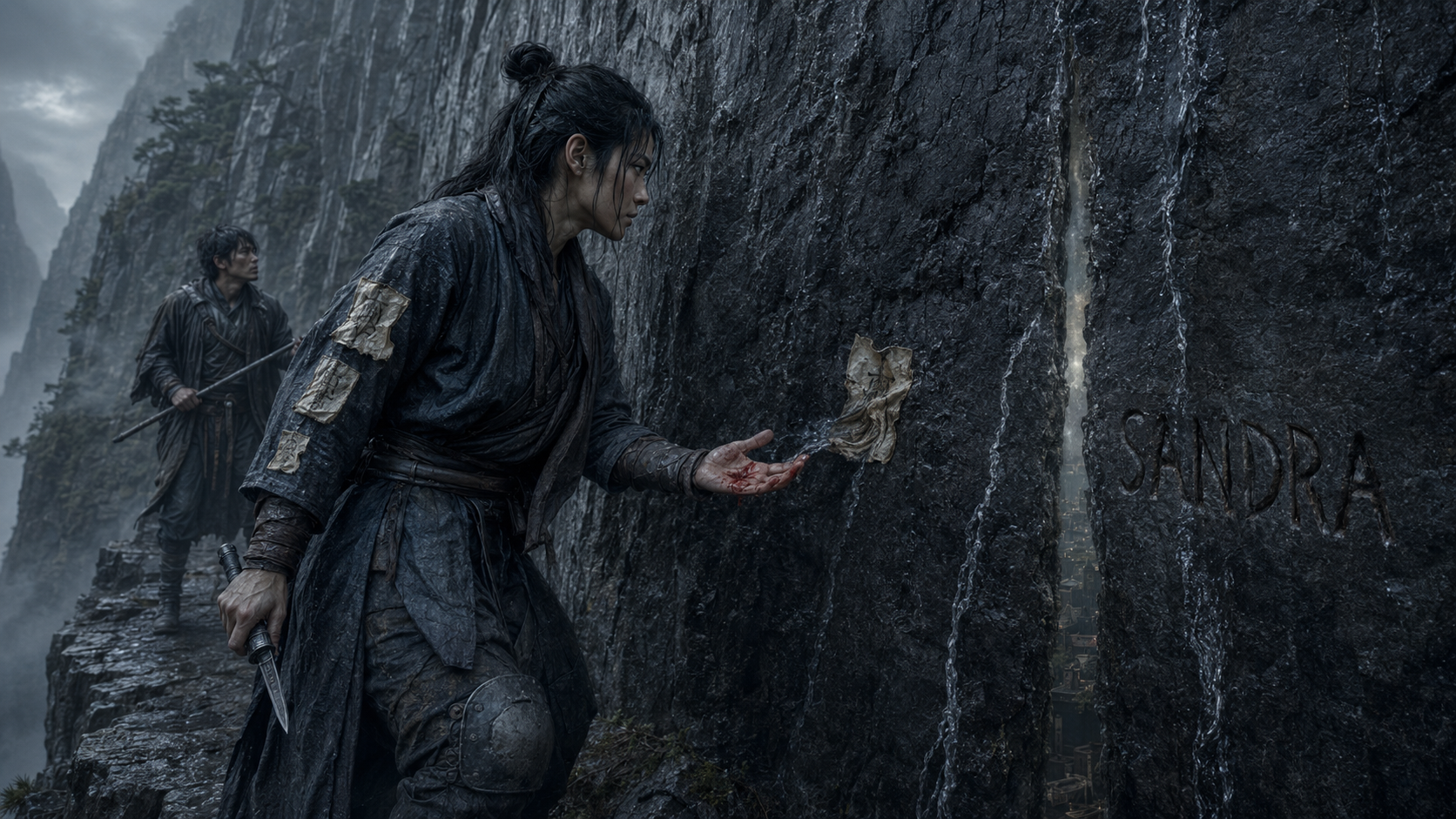
She stood in the east, below the Pale Cliffs, with a cracked knee guard, three wet seals fastened to her sleeve, and the unpleasant feeling that the stone was looking back.
Clan Mizuhara knew how to read flow. Not like the great names of Nexária or the Vector Houses, but well enough to notice when water, stone, and air stopped speaking to one another properly.
Here, nothing spoke properly.
Water from the spring was flowing upward. Only a finger’s width, and only when no one looked directly at it—but it was flowing.
“Lady Sena.”
Tomo stood behind her, gripping his short spear in both hands. He was too young to understand that fear was also information and old enough to pretend he felt none.
“Talk.”
“The seal at the third point went blank.”
Sena looked at the stone.
The seal had not gone blank.
It had been turned around.
The paper still clung to the wet wall, but its characters faced inward, as though someone had pulled the writing through from the other side of the rock.
“Don’t touch it.”
Tomo drew his hand away.
“I wasn’t going to.”
“You were.”
He fell silent.
The third thing that needed to remain true was that this was not an attack.
Clan Mizuhara was not there to invade the heights. They were only measuring a disturbance in the flow: a small contract, low pay, acceptable risk.
That was the official lie.
The truth was worse. Someone had paid them to discover why the Forgotten Mountain had begun bending water before it bent people.
Sena disliked faceless contracts. What she liked even less was pretending her house did not need Spiritual Silver to keep breathing.
She pressed two fingers to the stone.
Too cold.
“Collect the seals.”
Tomo blinked.
“All of them?”
“The ones that are still ours.”
Before he reached the first point, the water shaped a mouth against the stone.
It spoke without sound.
Tomo stopped.
Sena drew her knife and cut her own palm.
“Tomo.”
The young man did not answer. The mouth repeated something, and he took a step. His hand rose to tear the seal away.
“Tomo!”
This time, he turned in alarm.
“Did I answer?”
“I don’t know.”
“I heard my sister.”
“Your sister is in Nexária.”
“I know.”
The water smiled.
Sena smeared blood across the seal. The paper hissed, and for an instant the writing faced outward again. Then a word appeared on the stone, drawn in cold vapor.
Mizu.
Tomo read it.
“It’s the beginning of our name.”
“It isn’t a beginning. It’s shortened bait.”
The stone knocked.
Tak.
Tak.
Tak.
A pause.
Tak.
Then a fifth sound, lower than the others.
Sena tore the seal free with her knife. The stone exhaled hot air, like skin opening to breathe.
“We’re leaving.”
“Where do we go?”
Good question.
The paths that descended east and climbed toward the Mountain still existed. Between them, however, a third passage had just appeared.
Clean.
Narrow.
New.
It led into the stone.
“Not that way,” Sena said.
On the other side of the fissure, a square appeared for an instant. Sena saw people, a fountain, an axe, a woman with a short blade, a broad man facing dark water, a prisoner, and a child watching what he should not.
She stepped back.
“The Mountain is showing us the heights.”
“That’s impossible.”
“Yes.”
The fissure closed. In its place, the stone wrote another name—not in vapor, but as a cut.
Sandra.
Sena did not know that woman. Even so, she was certain the stone had chosen the wrong name on purpose.
In the square, Sandra ordered everyone to stay still.
No one obeyed completely. Frightened people always moved a little on the inside. Her task was to keep that little from becoming a step.
The five strokes were drying slowly. Wellington stood before them with one hand near his sword and his rib demanding payment for every breath. Arlo had recovered some of his color, but not his full name. Davi remained behind the fountain. Riku Takenaga stood beneath Kauã’s aim, giving away intent through his knees, shoulders, and breathing.
Sandra liked readable people.
Riku did not like being read.
Heren approached the marks with a bamboo rod, a Spiritual Copper coin, a piece of iron, and a strip of leather.
“Simple test?”
“Nothing is simple anymore,” Sandra replied.
“Then a small test.”
The coin, iron, and leather drew no response. When the bamboo reached the fourth stroke, the mark darkened.
“It didn’t choose the bamboo,” Heren said.
Wellington saw it.
“It chose the long stroke.”
“The axis,” Alessandra added.
Sandra turned to Riku.
“In the south, who held the axis of the formation?”
He smiled.
“You’re going to question me as if I were one of your men?”
Diogo took a step forward.
“Diogo,” Sandra called.
He stopped.
Riku saw the obedience and liked it.
“You have him well trained.”
Diogo smiled without humor.
“She gives orders to intelligent people too. Try her.”
Riku looked back at Sandra.
“I held the axis. I knew the route.”
“Then the Mountain marked you as the axis.”
“Or it marked the one who knew the way out.”
Wellington came closer.
“Did you get out?”
Riku did not answer. His face gave away the truth: he had not escaped.
He had been returned.
Sandra pointed at the fifth stroke.
“Who was the point?”
Riku stayed still for too long.
“Name,” Diogo demanded.
“No.”
“You’re very attached to your teeth.”
“He was a kid.”
The square went silent.
“Age,” Sandra said.
“Sixteen.”
“Name.”
Anger entered Riku’s defense.
“He was good. Better than plenty of old men.”
“Name.”
“Iori.”
The fifth stroke darkened.
Heren drew the bamboo away. The mark stayed black.
“Now it has the name,” Joel said.
Wellington looked at Riku.
“Or it already had it and wanted to see whether you would hand it over.”
The color left Riku’s face.
Diogo said the cruel part.
“Congratulations.”
Riku attacked.
His knee went for Diogo’s old rib injury. Diogo took the strike, closed a hand around the Takenaga’s shoulder, and released him at the exact moment Riku expected resistance. Riku passed beyond his own axis. Diogo’s forearm drove the air from his chest.
He retreated three steps. Kauã’s arrow was already aimed at his neck.
“Enough,” Sandra said.
Riku spat into the dirt.
“He said that about the boy.”
“And you stopped being a prisoner and became a fighter,” Wellington said. “Diogo stopped being a wall. Everyone looked.”
The mark faded slightly.
Alessandra understood.
“And while everyone was looking...”
The hinge snapped. The ledger bound against Joel’s chest opened inside the leather strap, and one page tore halfway free.
The paper flew toward the mark. Kauã pinned it to the ground with an arrow before it touched the fifth stroke.
Heren read it from a distance.
“A page of names. Children.”
Davi went still. Marta pulled him behind her leg.
Sandra walked toward the page slowly. Everyone needed to see how one approached something that wanted to be touched.
“Joel. Very quietly, only to me—tell me the names you remember without looking.”
“What if I forget someone?”
“Better to forget them now than hand them over on paper.”
Joel spoke near her ear.
Heren lifted the page with tongs. A brief green light kindled at the tip of Sandra’s blade.
The page burned with hardly any flame. It left behind the smell of ink and loss.
Davi began to cry. Marta did not tell him to stop.
Brina entered from the east with a woman bound at the wrist by patrol rope, though the knot was loose. She came by choice, not as a captive.
Her hair was tied high, her gray-blue clothes soaked at the sleeves, and three torn seals hung from one arm.
Riku took a step. Kauã aimed the arrow.
“No.”
He stopped.
The woman recognized him.
“Riku Takenaga.”
“Sena Mizuhara.”
Diogo made a low sound.
“The whole border decided to visit.”
Sandra faced Sena.
“You’re inside the village.”
Sena raised her hands.
“Not by choice.”
“No one enters here using that sentence.”
“Then take this as proof.”
She tossed a wet seal to the ground before the line of the square. The paper struck the earth without darkening or moving.
Heren picked it up with the tongs.
“A containment seal.”
Sena looked at him.
“It was.”
“What did it become?”
“An invitation.”
“For whom?” Wellington asked.
Sena looked at the fountain, then at Davi and the burned page.
“For what you protect.”
The square seemed smaller.
“Explain,” Sandra ordered.
“The spring opened a fissure, showed me this square, and wrote your name on the stone.”
“Who hired you?”
Sena remained silent.
Riku laughed.
“She won’t answer.”
Sena turned to him.
“How many of yours came back?”
His smile disappeared.
“One.”
“You.”
“Yes.”
“Then no one trustworthy came back.”
Riku advanced half a step. Kauã’s arrow was enough.
Alessandra asked the useful question.
“Which name did the stone write?”
Sena pointed at Sandra.
“Hers. Then it tried to form another, but it didn’t finish.”
Davi hid behind Marta.
“Davi,” Wellington said.
Sena’s silence confirmed it.
Only the fifth stroke remained dark.
Iori.
Davi.
The fifth place.
“It’s comparing points,” Wellington concluded.
Marta tightened her hold on her son.
“He is not anyone’s point.”
Sandra answered with truth, not gentleness.
“That’s why he stays behind me.”
Nilo entered from the north with Brás and Cíntia, all three covered in dust.
“Footsteps underneath the north.”
“How many?”
“Trying for five.”
Cíntia explained:
“It still gets the fourth wrong.”
Riku spoke quietly.
“It’s learning patrols.”
Sena studied the mark.
“It’s learning how clans work.”
“What did you say?” Sandra asked.
“In the east, it didn’t merely imitate our seal. It imitated the function: containment, flow, short barriers. If it took the Takenaga, it took false routes. If it took you...”
Sandra finished:
“It will try to learn protection.”
The fountain dripped once.
Toll.
The water reflected something that was not standing before it.
A child seen from behind, small and motionless at the southern edge.
“That isn’t me,” Davi said.
Riku took one step before remembering the arrow.
“Iori.”
In the reflection, the child raised one hand. Five separate strokes covered his palm.
“Is he alive?” Sena asked.
The image turned its face just far enough to show its mouth.
It smiled.
Riku went still. Diogo recognized the anger breaking him from within. That was how strong men became stupid.
“Iori,” Riku whispered.
The reflection knocked from inside the water.
Tak.
Tak.
Tak.
A pause.
Tak.
The fifth sound came like a bell.
Toll.
Riku lunged forward.
Diogo stepped in front of him without waiting for Sandra.
The Takenaga drove his entire shoulder into Diogo and tried to pass beneath his arm, using his own fall as a route. Diogo put a knee in the way.
“Move.”
“No.”
“He’s my apprentice.”
“He’s bait wearing your apprentice.”
Riku drew a hidden blade from his sleeve. Kauã’s arrow tore it from his hand before he could cut.
Without looking at the lost weapon, Riku head-butted Diogo in the chest, gained half a step, and reached his neck—a technique used by men who brought down larger opponents by pulling position instead of force.
Diogo trapped Riku’s wrist between his chin and shoulder.
“I know how to use a body too.”
He turned.
Riku landed flat on his back, ugly and graceless. The axe came down and buried itself a finger’s width from his ear.
The fountain trembled.
The child opened his mouth.
“Riku.”
It was a boy’s voice.
Riku squeezed his eyes shut.
Fury rose through Diogo. The axe answered, and the mark along its handle advanced.
“Diogo,” Sandra called.
“I know.”
“Know what?”
“That it wants me to break the fountain.”
The reflection smiled.
Diogo pulled the axe free. For one instant, everyone believed the blow was coming.
He turned his back on the fountain and struck the handle against his own chest.
Once.
The sound was dry. His Red Aura rose low, restrained and painful across his shoulders. The image shuddered.
Diogo spoke to Riku.
“He won’t come out because you run at him.”
“You know nothing.”
Diogo crouched beside him.
“I know what it is to arrive too late.”
The words did not comfort.
They cut.
“So stay alive until you learn whether that’s him.”
Iori’s image began to sink. Riku reached toward it without getting up.
The water answered. A quick thread shot toward his palm.
Diogo intercepted it with his own hand.
His skin hissed. He closed his fingers as a bitter charge climbed his arm.
“Now you owe me another one.”
Riku stared at him from the ground.
“Why?”
Diogo crushed the thread of water in his fist. The fountain gave a low toll, and the image vanished.
“Because I stopped you from being stupid.”
Sandra looked at Wellington.
“Reading.”
He studied the surface, which had returned to something too normal.
“It wasn’t just a reflection. It wasn’t the whole boy either.”
“What was it?” Riku asked.
“A piece. A name. Fear. Maybe a trace.”
“Alive?”
“I don’t know.”
The honesty did more damage than a lie.
Sena looked east.
“If it has the boy’s trace, it’s trying to pull in the rest of the team.”
Nilo pointed north.
“From underneath too.”
Kauã added from the roof:
“There’s still an invisible presence in the west.”
Heren looked at the hinge.
“And this still wants names.”
“Five fronts,” Joel murmured.
Davi answered in a small voice:
“Six.”
The boy pointed at the dish where the page had burned. Sandra had not allowed the ash to fall. In its place was a new mark.
A small, closed circle.
Five fronts were lines.
That was a center.
“It doesn’t only want to divide us,” Alessandra said.
Wellington finished:
“It wants to find out what remains at the center when everyone divides.”
The fountain dripped.
Toll.
Sandra looked at the five strokes, the circle, Davi, and the two men who still wanted to kill each other for different reasons.
“From now on, no one protects alone.”
Diogo flexed his burned hand.
Riku saw it. He did not thank him; he was not that kind of man.
“If Iori is alive, I’m going after him.”
“If you run without orders, I’ll break your leg before the Mountain uses it,” Diogo replied.
Riku gave him a dead smile.
“Try.”
Diogo smiled back.
The entire square felt it.
The real fight had not happened yet.
It had only chosen its moment.