Chapter 6 — The Patrol That Returned from the Wrong Side
Nilo heard the bell before the square did.
That should not have been possible.
The square stood high above, and the bell stood in the square. Nilo was in the north, between two cold stones on the Watchers’ Escarpment, with four cultivators behind him and the wind cutting at his ear.
Even so, the sound came from beneath his feet.
Toll.
The other four stopped. Brás, armed with a short spear, looked down at the ground.
“Did that come from the stone?”
Nilo raised a hand. No one moved.
The northern line was trained for three things: see first, delay first, and return before becoming a corpse. These were not children carrying sticks, but cultivators of the Mountain—people capable of breaking the bones of small beasts, holding a trail against intruders, and charging dearly for every meter taken.
But the Mountain was not a stranger.
It was home.
And home had begun to answer wrong.
Toll.
The sound returned, closer. A sliver of ice broke loose from the high stone and shattered on the ground into three small pieces and one long.
Brás swore.
“A mark.”
Nilo studied the edge of the trail. The first northern marker remained in place. So did the second.
The third had turned toward them.
Nilo had driven it in two days earlier. Its marked face was supposed to look out of the Mountain, never in.
“No one touches it.”
Cíntia already had a hand on her knife handle.
“I wasn’t going to touch it.”
“Your hand was.”
She drew it away.
The wind changed without gaining strength. Instead of descending, it began to climb the escarpment. Nilo breathed through his nose and smelled cold stone, broken pine, and stagnant water.
Brás noticed too.
“Water in the north?”
The fountain stood at the center of the village. The north never smelled of the fountain.
Behind them, Tadeu crouched and touched the earth with two fingers. His aura was weak, but it served him well for reading the ground: lost goat, foolish intruder, heavy beast. When he raised his hand, his fingers were clean.
“No tracks.”
A narrow band of dustless earth ran between the stones, as though someone had carefully swept a path.
“We’re going back,” Nilo decided.
Brás turned to him.
“Already? We haven’t even confirmed the third marker.”
Nilo looked at the turned bamboo.
“We just did.”
The bell tolled again.
Toll.
The clean band advanced a finger’s width toward them.
“Village. Now.”
They went back quickly, without running. Running taught panic to the body, and a panicked body chose the wrong trail.
Halfway home, Tadeu stopped so abruptly that Nilo nearly walked into him. To their left there should have been low brush, gray stone, and an old pit where children were forbidden to play.
Now there was a bamboo grove.
Narrow. New. Clean.
A piece of the south planted in the middle of the north.
Cíntia went pale.
“That wasn’t here.”
Brás raised his spear.
“Bamboo grows fast, but not like that.”
Nilo stepped back. The stalks struck one another on their own.
Tak.
Tak.
Tak.
A pause.
Tak.
None of them spoke. The fifth sound did not come—and waiting for it was worse than hearing it. The thing had broken the rhythm as though it wanted someone else to complete it.
Nilo closed his hand.
“No one answers.”
The bamboo opened into a narrow passage, clean and inviting. Brás took half a step without noticing. Cíntia caught his sleeve.
“No.”
He blinked.
“I…”
“I know.”
Nilo understood. It was not pulling Brás’s foot; it was pulling his function. He was the patrol’s first shield. Faced with an open passage, his body wanted to take the front.
The Mountain knew that now.
“Break formation,” Nilo ordered. “Cíntia in front. Me at the back. Brás in the middle.”
Brás did not like it.
“This is ridiculous.”
“That’s why it works.”
They changed positions. The bamboo grove went still.
The skin on Nilo’s arm prickled, not from fear, but confirmation. The thing expected habit. When the habit changed, it had to recalculate.
This time, the patrol reached the village by the right path.
Or almost.
The square was full of people, but it no longer looked like a center. It looked like a knot.
Sandra stood beside the fountain, short blade in hand and eyes on five places at once. Wellington sat on the stone step, a bandage around his chest, his arm wounded, wearing the expression of a man who wanted to stand but was being restrained by every bone in his body. Diogo occupied the southern exit without needing another order. Alessandra spoke with Marta and Davi near the children.
Kauã was nowhere in sight. Therefore, he was somewhere useful.
Nilo stopped at the edge of the square and raised a hand.
“North altered.”
Sandra turned only her face; the rest of her continued to command.
“Short report.”
“Third marker turned inward. Smell of the fountain on the escarpment. Bamboo on the way back.”
Diogo looked over his shoulder.
“Bamboo in the north?”
“Yes.”
Wellington raised his head.
“Did it knock?”
“Three short. One long.”
The square lost a little of its air. Sandra did not.
“Wounded?”
“No.”
“Losses?”
“None.”
“You came back early.”
“I came back alive.”
Sandra nodded.
“Good decision.”
Nilo received the praise as weight, not reward.
A goat bleated near the corral. Marta closed her arms around Davi.
But the animal was not in the corral. Since the night before, it had been tied near the fountain.
The bleat had come from the west.
Diogo started walking. Sandra caught his arm.
“You stay.”
“A bleat in the west, a mark in the north, the south closed—and I stay?”
“You stay.”
“That word is becoming personal.”
“It’s becoming necessary.”
Wellington tried to stand. Sandra pointed at him without looking.
“You too.”
“Can I send my spirit?”
“You can tell it to sit.”
Heren came out of the workshop carrying an iron rod, a strip of leather, and a grim expression.
“The storehouse is hot.”
Joel followed him out.
“The storehouse isn’t hot. The hinge is hot.”
“The hinge is part of the storehouse.”
“That doesn’t help.”
Sandra pointed Alessandra toward the building.
“Storehouse.”
She nodded and left with Heren and Joel.
“Kauã,” Sandra called.
The answer came from the roof of Marta’s house:
“Saw it.”
“West.”
Kauã vanished before the word ended.
Diogo opened his mouth, found Sandra’s gaze, and gave up.
Wellington studied the ground. A night of people packed into the square should have left adult and child footprints, animal tracks, ash, water, and spilled food. Instead, clean lines ran between the groups—not whole paths, only suggestions of where someone would go if they needed to run.
“Sandra.”
“I know.”
“You don’t know all of it.”
She looked at him.
“Then speak.”
Wellington pointed to three bands: one linked the fountain to the storehouse; another ran from the square to the south; the third led from the center to the children.
“It isn’t opening a passage. It’s drawing a choice.”
Davi stood at the end of the last line. When Marta noticed, she pulled the boy aside. The band remained pointed at the place where he had been.
It did not follow him.
Wellington’s stomach tightened.
“It’s late.”
“What is?”
“The map.”
He stood before Sandra could stop him. His rib bit hard, but the pain belonged to him. The ground had no right to use it.
Wellington crouched before the band and let the Rose Aura rise close to his skin, low enough not to offer itself, strong enough to give the world edges.
The line had no smell, dust, or heat. It was absence arranged.
“Don’t step here.”
A woman backed away with her daughter in her arms. Sandra raised her voice:
“Everyone away from the clear lines. Slowly. No one crosses a clean path.”
The order worked for four breaths.
Then the west screamed.
It was not a goat. It was a man.
Diogo took one step. This time, Sandra allowed it.
“West. Bring back only information if you can. If you can’t, bring people.”
He smiled without joy.
“Now you’re speaking properly.”
He left with the axe across his back, part of his own body.
Wellington wanted to follow. Sandra did not even need to look.
“You stay where you can think.”
“I think while walking.”
“Not today.”
Nilo was still at the edge of the square.
“The north didn’t come to attack.”
Wellington stared at him.
“What did it come for?”
“To make us change positions. The passage opened when Brás was in front and went still when we changed formation.”
Sandra’s face changed little, but it changed.
“It’s reading function.”
“Yes,” Wellington confirmed.
“Not only name.”
“Not yet.”
The final word weighed more than it should have.
Inside the storehouse, the hinge cracked.
“No one touches the door,” Alessandra warned.
Joel answered:
“I wasn’t going to.”
Heren corrected him:
“Your hand was.”
Wellington almost laughed. The urge died when steam rose from the hinge. A thin line of smoke climbed from the metal, not toward the sky, but south.
Alessandra appeared in the doorway.
“The hinge is marked on the inside.”
“Same mark?” Sandra asked.
“No. Three short, one long, and a stroke across them.”
The information met another thought inside Wellington.
“A variation.”
“Yes.”
“What changed?”
Alessandra looked at the hinge.
“Before, the mark called. Now it keeps the door from closing.”
Joel went white.
“My door won’t close?”
Heren pushed it with the handle of his tool. The wood met the frame, drew back a finger’s width, and met it again.
Tak.
Tak.
Tak.
A pause.
Tak.
The storehouse had learned to knock from within even while open.
Sandra lowered her voice.
“Heren, secure it open. Joel, get the ledger out of there. Alessandra, see whether there’s a line to the food.”
“I already did.”
“And?”
Alessandra looked toward the square.
“It doesn’t lead to the food. It leads to the names.”
Joel hugged the ledger.
“No.”
The door struck again, harder.
Another scream came from the west. This time, Diogo answered with an impact that made the ground shake. The entire square turned that way.
Sandra did not.
She looked at Nilo.
“North stays with me. East?”
A woman came running down the trail from the Pale Cliffs. Brina had blood on her forehead, though it did not seem to be hers.
“East returned twice.”
Sandra narrowed her eyes.
“Explain.”
“We went to check the clear spring. We reached it, returned, and entered the square. Except…”
Brina looked back. Three cultivators from her team appeared at the eastern exit.
The fifth did not.
Sandra counted.
“Where is Arlo?”
Brina searched for breath.
“He came back with us, but he entered from the north.”
Nilo turned.
On the other side of the square, Arlo appeared between the houses. He walked slowly, wet from shoulders to waist. Every drop fell without sound.
He looked awake. That was the problem. His eyes were open, but they carried none of the urgency of anyone alive.
Sandra raised a hand.
“No one goes near him.”
Arlo stopped. The water kept running from him.
Brina stepped forward.
“Arlo?”
He turned his head toward her, slowly.
“The spring closed.”
The voice was his. The pause was not.
Wellington increased the Rose Aura slightly. The air took shape around Arlo.
There was no shadow behind him, only wet ground.
“Arlo,” Sandra called.
He turned.
“Full name.”
His mouth opened, closed, then opened again.
“Arlo.”
Sandra exposed a finger’s width of blade.
“Full name.”
The water stopped dripping. Arlo looked down, as though waiting for the rest of the answer to come out of the ground.
“Arlo.”
Diogo emerged from the western road carrying a man over one shoulder.
The man was not from the village. He wore dark leather, an armband, and tall boots covered in gray mud. His face was bleeding, and a broken knife remained clenched in his hand.
Kauã followed behind, bow drawn, arrow aimed at the stranger’s nape.
Diogo threw the man to the ground.
“Found this trying to run.”
Sandra did not look away from Arlo.
“Alive?”
“Unfortunately.”
The stranger spat blood.
“I didn’t come up.”
Diogo planted a foot on his chest.
“Bad start.”
“He came from the west, but his boots are from the south,” Kauã reported.
Nilo saw the gray mud. It came from neither the north, the square, nor the high western trail.
Wellington compared Arlo and the intruder: a man from the village returning without his full name; another swearing he had not come up. An internal front and an external one, in the same minute.
That was no coincidence. It was pressure spread across fronts.
Sandra understood too.
“Diogo, take your foot off him. Don’t kill him before he becomes useful.”
“He tried to cut Kauã.”
Kauã corrected him:
“He tried to cut where I would have been if I were slower.”
“Worse.”
The stranger struggled to breathe.
“I didn’t come up. The trail spat me out here.”
Wellington approached. Sandra did not stop him; perhaps she needed his reading, or perhaps there were no longer enough people to keep everyone still.
“Which clan?”
The man laughed, leaving blood between his teeth.
“None you can hold to account.”
Diogo tilted the axe.
“I hold people to account too.”
The intruder’s courage diminished.
“Takenaga.”
Nilo held his breath. It was a small southern clan, known for false guides, ambushes, and smuggling—people who understood bamboo groves better than honest people ought to.
“Why were you on the western edge?” Sandra asked.
“I was in the south.”
“Lie,” Diogo said.
“I know where I step.”
Wellington studied the boots: southern mud, a cut from western stone along the side, a piece of bamboo caught in the buckle, and clear water dripping from the sole.
South, west, and east gathered on the same man.
“It isn’t a lie,” Wellington concluded.
Diogo turned to him.
“He tried to cut Kauã.”
“That is also true.”
“You’re making his life complicated.”
“The Mountain got here first.”
Arlo took a step. Everyone remembered him at the same time.
The water began to drip again.
Tak.
Not the sound of a drop, but bamboo against stone.
Brina tried to approach. Alessandra caught her arm.
“No.”
“He belongs to my line.”
“Then listen more closely.”
Arlo opened his mouth.
“The spring closed.”
“You already said that,” Sandra replied.
He blinked and, for the first time, looked afraid.
“I did?”
Wellington moved closer.
“What did you see at the spring?”
“My face.”
“In the water?”
“In the stone. The spring was dry and the stone was smooth. My face was in it, but I was standing behind myself.”
Brina closed her eyes.
“Arlo…”
“I heard all of you calling me.”
Sandra asked:
“Who called?”
Arlo looked at Brina.
“Everyone.”
“Lie,” she said.
“I know.”
At last, his voice broke and became his again.
“I know.”
The water fell faster.
Tak.
Tak.
Tak.
A pause.
Tak.
The Takenaga began to laugh on the ground, low and without joy. Diogo pressed him down again.
“Something funny?”
“You’re lost too.”
Sandra looked at him.
“Too?”
The man swallowed the laugh. Wellington understood that it was not mockery, but a wretched kind of relief. People who find someone else lost feel less condemned.
“How many were with you?” Sandra asked.
Silence.
Diogo raised the axe.
“She asked you.”
“Five.”
Kauã appeared behind the prisoner.
“I saw only one.”
“Because the others weren’t spat out here.”
“Where are they?”
The man looked toward the southern exit.
“If the trail was fair, dead.”
Wellington crouched beside him.
“And if it wasn’t?”
The Takenaga met his eyes.
“Worse.”
The storehouse knocked again. The open door drew back, and the ledger’s cover pulled away from Joel’s hands. Heren seized the book with him.
The pages opened and turned too fast. Alessandra placed a hand over the paper. A thin blue line shone around her fingers—not armor, not a full technique, only a boundary.
The pages stopped on one entry. Joel’s face came apart.
“No.”
Sandra was still watching Arlo, the Takenaga, and the bands on the ground.
“Speak.”
Joel wet his lips.
“It’s the page for the Two Hundred Fund.”
Marta embraced Davi.
Heren looked at the crowded square.
“Food, wounded, elderly, children…”
“People who depend on the entire village,” Alessandra finished.
The clean line moved toward the fountain.
Wellington drew his sword halfway. The Rose Aura entered the blade like a held breath, and the band stopped before the new fence. It did not retreat.
Sandra spoke softly:
“It’s choosing what weighs most.”
“No,” Alessandra corrected. “It’s discovering what we cannot abandon.”
Arlo fell to his knees. Brina tried to run to him, but Sandra pointed the blade.
“Stay.”
Arlo vomited water—more than his body could have held. The liquid spread across the square without following the slope and ran in four directions.
North. East. West. South.
Each stream stopped before a different person: Nilo, Brina, the fallen Takenaga, and Joel.
Wellington understood.
“Lines.”
“Which ones?” Sandra asked.
“Defense, spring, intruder, and sustenance.”
Diogo took his foot off the prisoner and placed himself between the water and Joel.
“And me?”
The stream near Joel drew back a finger’s width.
“You are the answer it already expected,” Wellington said.
Diogo did not like that.
“Then I’ll be another one.”
He left Joel and went to Arlo. The water took half a second to adjust.
Half a second was enough for Sandra.
“Change functions.”
The order crossed the square. Nilo pulled Brás into a different position. Brina left Arlo and went to the ledger. Kauã climbed down from the roof and appeared beside Joel. Diogo took the fountain. Alessandra held the line between the water and the children. Wellington stepped back from the clean band.
Sandra remained in the center.
For an instant, nothing answered. The Mountain had learned habits, not improvisation.
Yet.
The water around Arlo trembled. The Takenaga began to breathe faster.
“What did you do?”
“We changed places,” Sandra answered.
“That won’t hold.”
“It doesn’t need to hold forever,” Wellington said. “Only until it misreads us next.”
The clean band darkened without advancing, as though irritation also had a color.
Then the sound came from the north, the east, the west, and beneath the square at once.
Tak.
Tak.
Tak.
A pause.
Tak.
Then, lower, a fifth sound.
Not a point. An answer.
Davi began to cry without sound. Marta held him tighter.
“What is it?”
He pointed at Arlo.
“He came back with something behind him.”
Brina went pale. Arlo raised his face.
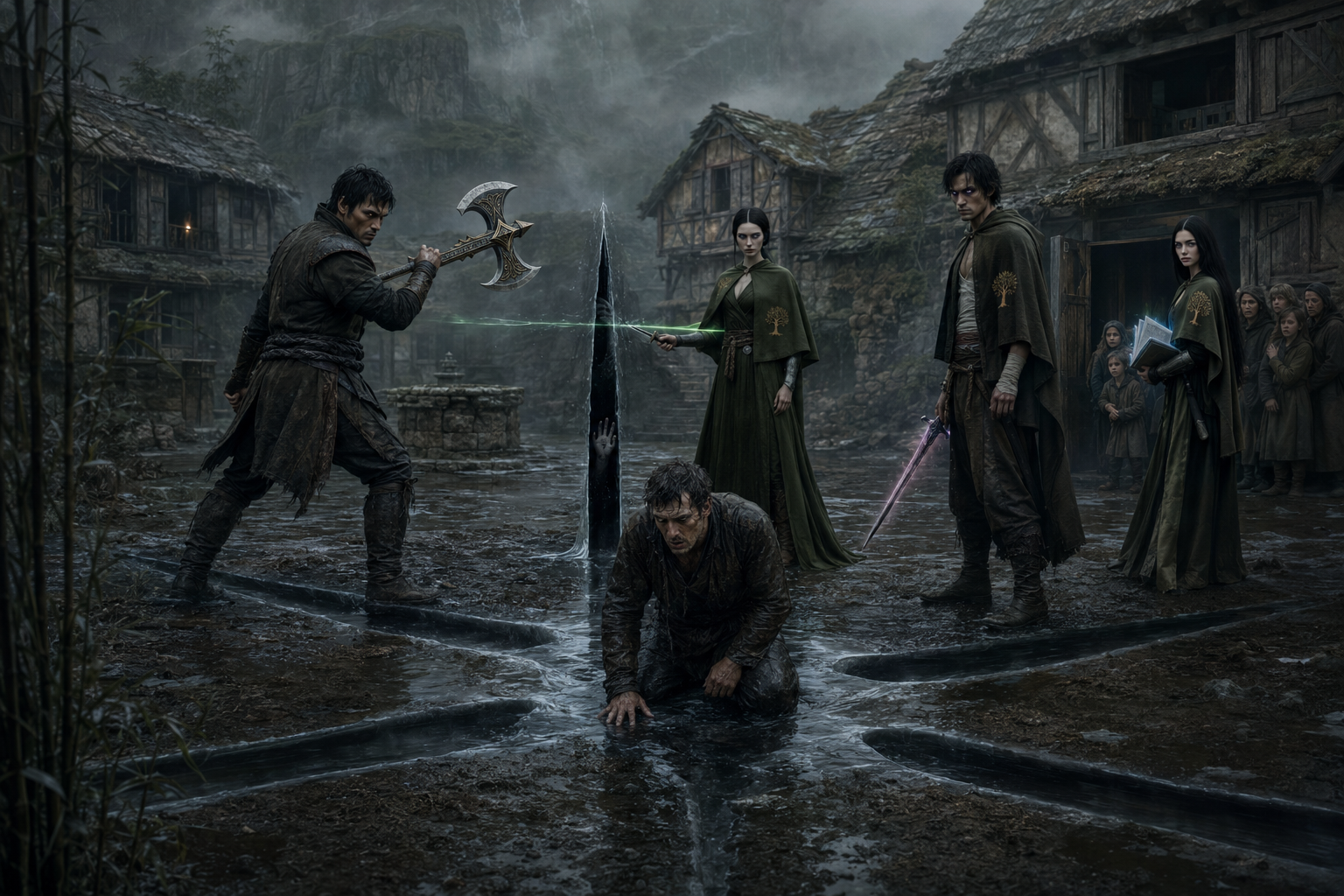
Behind him, the water formed a shadow—not a man’s shadow, but a door. Low, narrow, made of standing water and clean ground.
Sandra raised her blade.
“Everyone back.”
The Takenaga tried to crawl away. Diogo stepped on his clothes.
“You stay.”
“That thing isn’t yours.”
“Neither are you.”
The water door opened a finger’s width. The air that escaped smelled of a closed spring, new bamboo, and stored iron.
Wellington’s rib hurt in the same place where the beast had struck him.
Fissure. Fountain. Storehouse. Houses. Patrol.
This was not an invasion through one path. It was a map asking questions.
Sandra cut the air before the door. The Green Aura passed thin and precise. The opening did not close, but it stopped growing.
Sandra narrowed her eyes.
“I can’t cut it whole.”
Wellington studied the water.
“Because it isn’t whole here.”
Without turning his body, Kauã pointed south.
“Movement in the bamboo.”
Nilo looked north.
“The marker turned again.”
Brina held the ledger of the Two Hundred Fund.
“The page is getting wet.”
Heren spoke from the storehouse door:
“The hinge is cooling.”
Joel blinked.
“Is that good?”
“I don’t know.”
Diogo laughed once, short and ugly.
“Four problems.”
Sandra looked less surprised than tired of being right.
“Five.”
Everyone followed her gaze. Davi stared at the water door, and the door stared back.
It had no eyes. Even so, it watched.
Sandra sheathed her blade halfway.
“Split. Nilo, north with two. Brina, east with two. Heren and Joel, storehouse. Kauã, south from above. Alessandra, children and ledger. Diogo…”
“Door.”
“Door.”
He smiled with something close to eagerness.
“Finally.”
Sandra looked at Wellington.
“You stay with me.”
“I thought I was going to sit.”
“You’ll think standing up.”
“Progress.”
The Takenaga looked from Diogo to the door.
“If you strike that, it learns you.”
Diogo rested the axe on his shoulder.
“Then it’ll learn properly.”
Wellington looked at the stranger.
“Why are you warning us?”
The man laughed softly.
“Because there were five of us in the south.”
The door opened another finger’s width. His voice failed.
“And it returned only the worst of me.”
The water darkened. For an instant, a hand appeared on the other side.
It did not come out. It waited.
Across the palm were three short scratches, one long, and a fifth point—small, wet, recent.
Davi whispered:
“Now there are five.”
Wellington felt the weight of the sentence cross the square.
Three short. One long. One point.
It was not merely a mark.
It was a count.
Sandra said what no one wanted to hear:
“It learned how to count a patrol.”