Chapter 5 — The Bell Without a Rope

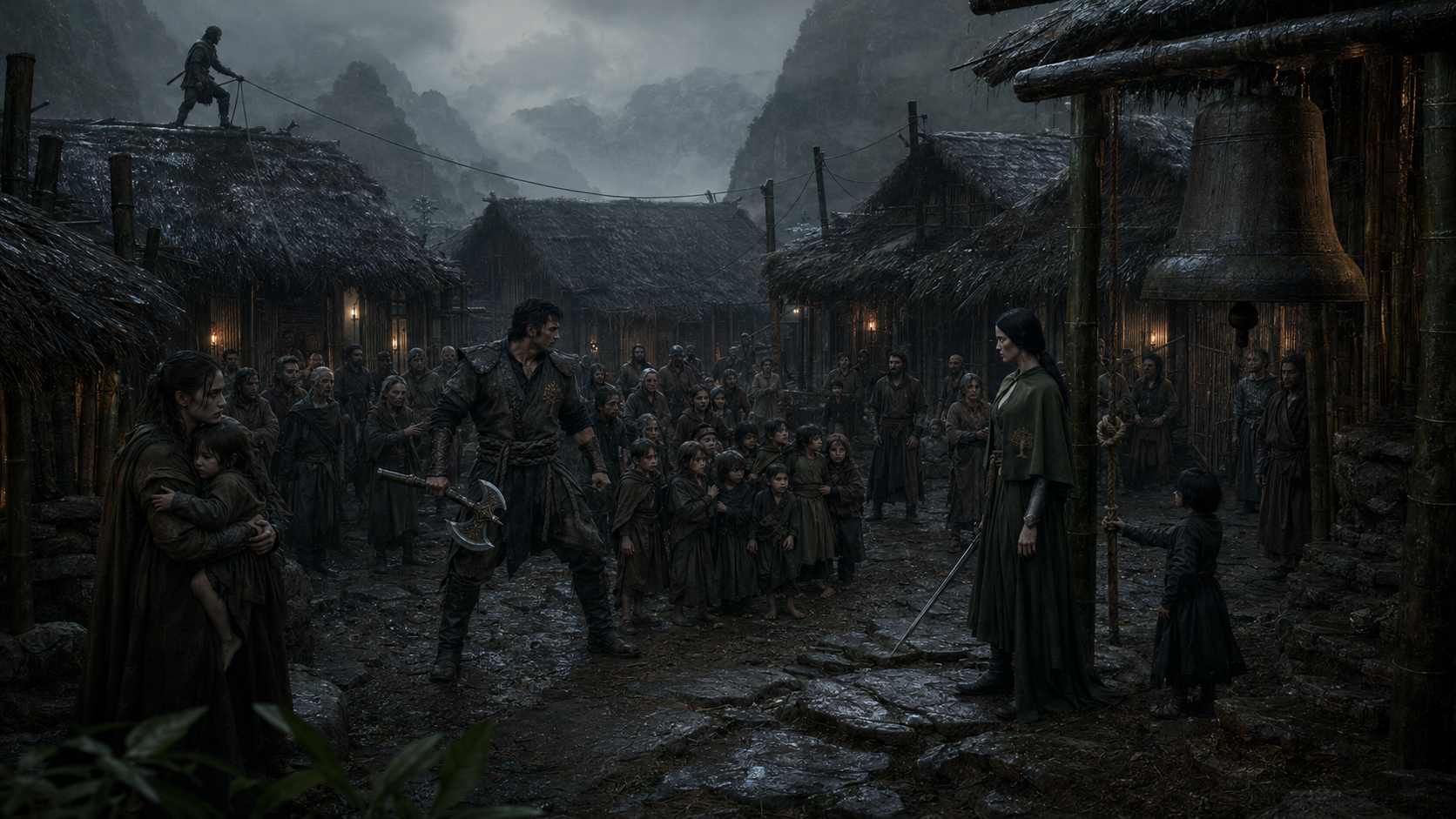
The whole village fit into the square.
Not comfortably. It fit the way frightened people fit: shoulder to shoulder, children in the middle, elders seated wherever there was room, animals tied near adults, forgotten cooking pots in laps, and knives in the hands of people who had never learned to use them properly.
Sandra did not call it shelter. She called it order.
“Children in the center. Two adults on each side. No one stays alone. No one answers a call without seeing a face.”
No one asked for how long. The question had already lost its use.
The doors of the houses kept knocking from within, one after another, sometimes three in a row. Something passed from house to house, testing wood, latch, stool, bed, and name.
Tak.
Tak.
Tak.
At every knock, someone looked back. With every glance, Sandra discovered who was close to running.
“Eyes on the square.”
People obeyed, not out of calm, but for lack of a better option.
Diogo stood between the children and the houses. He did not need to say anything. His body already said it: you go through me first.
Kauã moved across the low roofs, tethered to the village by thin ropes he had tied between eaves, posts, and the workshop. He made no noise. He simply appeared somewhere else whenever anyone began to think he had vanished.
Alessandra walked the edge of the square, counting doors, windows, shadows, and empty spaces. Heren carried tools in one hand and a strip of bamboo in the other. Joel clutched the ledger as if even the storehouse might escape him.
Marta sat on the ground with Davi in her arms.
He was no longer crying, and that was worse. A child who cries still lets fear back out. Davi was beginning to keep it inside.
Wellington noticed and looked away. Rib, arm, and chest all hurt, but nothing troubled him as much as the sense that the village had stopped breathing the right way.
He approached Sandra.
“It’s gathering us together.”
“I know.”
“It wasn’t an accident.”
“I know.”
“If it wanted us to come to the square…”
“Wellington.”
He fell silent. Sandra was looking at the bell.
Fastened to an old crossbeam near the fountain, the bell served to summon the patrol, warn of fire, or gather people when a goat went missing, a child disappeared, or someone returned wounded from the trail.
It was an ordinary bell.
Until that day, that would have been a safe sentence.
Rope and metal remained still. Even so, Wellington felt an urge to look at them.
“Heren.”
The smith had already noticed. He approached without touching the bell and passed the bamboo near the rope.
Nothing.
He passed it near the metal. The fiber vibrated, and Heren drew his hand away.
“It’s cold.”
Joel frowned.
“Bells get cold.”
“Not on the inside.”
Diogo studied the crossbeam.
“If it rings, I tear it down.”
“No,” Sandra said.
He did not even argue. He only tightened his hand around the axe.
Alessandra stopped before the fountain. The water ran again, but too quietly, as though trying not to draw attention.
“The bell doesn’t want to ring.”
Wellington looked at her.
“Then what does it want?”
Alessandra took too long, and the delay was enough.
Davi answered:
“It wants someone to ring it.”
Marta pressed him to her chest.
“Be quiet.”
“But it does.”
Sandra turned to the boy.
“Did you hear it?”
Davi shook his head, then let the gesture become uncertainty.
“Not with my ears.”
The sentence entered the square wrong. Sandra did not rebuke him.
“Where?”
He pointed to his own belly. Marta closed her eyes.
“He’s afraid.”
“Everyone is,” Sandra said. “But he still answers.”
Davi stared at the bell.
“It feels like wanting to get up before anyone calls you.”
Kauã appeared on the workshop roof.
“People are taking half-steps.”
Sandra examined the square. It was true. No one had left their place, but several feet had shifted position.
Half a step. Almost nothing. The kind of movement people deny because they do not even realize they made it.
Wellington looked at the bell again. The rope remained still. The urge did not.
“It isn’t calling through sound.”
“It’s calling through habit,” Alessandra finished.
Heren swore under his breath.
“Worse.”
Diogo looked at him.
“How is habit worse than a beast?”
Heren pointed at the square.
“You can see a beast coming.”
The bell tolled.
Once, without force. Just enough.
Toll.
Half the square took a step.
Sandra raised her blade.
“Stay.”
The movement died. A child began to cry; an old man clutched his chest; Marta locked both arms around Davi. Diogo broadened his shoulders as if he could hold the entire village in place.
The bell had not moved. The rope had not swayed. The metal had not vibrated.
Even so, everyone had heard it.
The Rose Aura rose beneath Wellington’s skin. He contained it before the order came.
Sandra noticed.
“Good.”
He almost smiled.
Almost.
The bell tolled again.
Toll.
This time, no one walked. Everyone wanted to—and the wanting showed in throats, fingers, knees almost bending, children searching for their mothers, adults searching for an order.
Sandra said nothing. Silence was also an order when it came from her.
The square resisted.
The bell answered with a different sound.
Tak.
Not metal. Wood against stone. The same rhythm.
Diogo growled.
“It’s angry.”
“It’s testing,” Wellington said.
“Same thing to me.”
Heren moved closer to the crossbeam and examined the rope.
“It’s clean.”
Joel grimaced.
“That became a bad word.”
“It did.”
Heren pointed to the knot: three short turns and one long. It had not been tied that way before.
Sandra turned to Joel.
“The record.”
He opened the ledger.
“Bell inspected three days ago, rope replaced two weeks ago, simple knot. I wrote it down because Heren complained that the old knot had been tied by a drunk.”
The smith did not take his eyes off the rope.
“It had.”
The bell called for the third time.
Toll.
A woman stepped forward. Kauã loosed the arrow before she completed the movement. The arrowhead did not strike her; it buried itself in the earth before her foot.
The woman froze.
“Apologize later,” Kauã said from the roof.
Sandra answered:
“You don’t apologize for stopping someone from dying.”
The woman began to tremble.
“I didn’t want to go.”
“I know.”
Hearing that was worse than being accused.
Wellington looked at the bell.
“If it learns to call through routine, it doesn’t need to enter a house.”
Alessandra followed the thought.
“It only needs to make the village obey what it already obeys.”
Bell. Mother’s voice. Child’s place. Storehouse ledger. House door.
Nothing came as an attack. It came as custom. The thing was learning where the village lowered its guard.
Davi moved in Marta’s arms.
“I heard it before.”
Sandra turned slowly.
“Before what?”
“Before the bell rang.”
“What did you hear?”
Davi hesitated. Marta rested her forehead against his hair.
“Speak.”
“The wood breathed.”
Heren looked at the crossbeam. The rope rose a finger’s width on its own.
Diogo left his place, but he did not go to the bell. He went to Davi and stood between the boy and the beam.
Large. Quiet.
The rope stopped moving.
Wellington saw it. Alessandra did too.
“It didn’t want Diogo,” she said.
He looked at her.
“What didn’t?”
“The summons.”
Wellington understood.
“It wants whoever answers easily.”
Diogo looked at the children in the center of the square. His anger changed shape and went cold.
“Then let it call past me.”
The bell tolled.
Toll.
Diogo did not move. The rope struck the beam.
Tak.
Toll.
Tak.
Toll.
The rhythm quickened. Children cried. Some adults closed their eyes.
Sandra raised her voice for the first time:
“No one answers.”
The rope wound itself: one turn, two, three. The long turn came last. Then the knot descended to the height of a hand.
The height of a child.
Wellington took a step. Sandra allowed it.
He stopped in front of the rope, feeling the call deep in his chest. Not as a voice, but as a borrowed habit.
If the bell rings, the village goes.
If a mother calls, her child goes.
If a door opens, its owner enters.
If a place is empty, someone sits.
Simple. Terrible.
Wellington looked at Davi. The boy was pale, but he had not walked.
“Davi.”
“What?”
“When the bell rings, who tells you to go?”
The boy sniffed.
“Sandra.”
“Not the bell?”
“No.”
“Who tells you to answer your mother?”
Davi looked at Marta.
“My mother.”
“Not the voice?”
He understood a little—enough.
“No.”
Wellington met Sandra’s eyes. She had already understood.
“Everyone listen,” she said to the square. “The bell does not command. The voice does not command. The door does not command. The place does not command.”
The bell trembled.
Sandra stepped forward.
“The one who commands has a face.”
The rope stretched taut.
“Whoever calls gives a name.”
The crossbeam groaned.
“Whoever enters has a hand.”
The fountain stopped running.
“Whoever belongs has a witness.”
The bell made a cracked sound.
Toll.
No one moved. Not even half a step.
Marta was the first to repeat it:
“Whoever calls gives a name.”
Joel came next, quietly:
“Whoever enters has a hand.”
Heren looked at the bell as if he wanted to dismantle the world.
“Whoever belongs has a witness.”
Other voices joined them. Not in chorus, not beautifully. Each person repeated it in their own way, with fear, anger, or a broken voice.
But they repeated it.
At last, the bell swung. Real metal. Real sound.
Toll.
Because it was real, it lost its power.
Diogo smiled.
“Ah.”
Sandra looked at him.
“No.”
“I didn’t even say anything.”
“You thought loudly.”
Wellington picked up one of the bamboo slivers Heren had left near the fountain. Instead of bringing it close to the bell, he placed it between the rope and the children.
“This does not pass.”
The rope descended, touched the sliver, and stopped.
Kauã was already on another roof.
“The doors stopped.”
Alessandra looked at the houses, one by one.
“They didn’t stop.”
Wellington followed her gaze.
The doors were no longer knocking. All of them stood open from within, only a finger’s width—like Marta’s house.
The village held its breath.
Sandra did not look back.
“No one leaves the square.”
One door creaked. Then another. Then all of them fell quiet.
Wellington felt the thing waiting, not with patience, but with calculation.
Diogo felt it too.
“Now it wants us to go close them.”
“Yes,” Alessandra answered.
“Then we don’t close them.”
Joel nearly choked.
“Sleep with the doors open?”
Marta looked at the houses.
“Sleep?”
No one had thought of that word until it appeared. Sleep meant letting the body become trust. That night, trust looked like a door open from within.
Sandra lowered the blade just enough to show that she was still calculating.
“No one sleeps at home. Today, the square becomes home.”
No one liked it. No one argued.
Kauã pointed north.
“If everyone stays here, the edges weaken.”
“You close the edge.”
“Alone?”
“No.”
Sandra looked at Diogo. He raised his eyebrows.
“I thought I was the wall.”
“Walls have corners too.”
“That was almost a compliment.”
“Don’t ruin it.”
Wellington drew a short breath and hid it poorly.
Sandra turned to him.
“You stay in the center.”
“I can help at the edge.”
“You can barely help your rib.”
“That sentence is hunting me.”
“Because it runs faster than you today.”
Davi laughed. It was a small, frightened sound, but it changed the square a little. It reminded everyone that there were still people there—and people were not only targets.
The bell trembled without ringing.
Heren approached the crossbeam.
“Can I remove the clapper?”
Sandra thought.
“If you remove it, you teach absence.”
“If I leave it, it tries to ring.”
“Then bind it without cutting.”
Heren smiled for the first time that day.
“Now you’re speaking my language.”
He climbed onto the base of the beam carrying a strip of leather, two bamboo slivers, and a piece of heavy cloth. He bound the clapper from above. He did not remove or break it; he merely kept it from moving.
The bell tried to ring and failed. The rope drew taut while the tip of the sliver on the ground began to darken.
Wellington stepped on it.
Sandra turned.
“Wellington.”
“It isn’t a technique.”
“Is it stupidity?”
“It’s a foot.”
The sliver stopped darkening. Cold climbed through his sole, weak and curious, like a tongue tasting skin.
Wellington did not retreat.
Diogo noticed.
“Want to trade feet?”
“I want you to stay where they put you.”
“Then don’t do things that make me want to leave my place.”
The rope fell limp. The bell went mute.
For three breaths, the square believed it had defeated something.
Then the sound came from below.
Not from the beam, the metal, or the doors. From beneath the square.
Toll.
Davi covered his ears. Marta embraced him. Joel dropped the ledger. Heren climbed slowly down from the beam. Alessandra closed her eyes while Kauã turned south. Diogo raised the axe.
Sandra and Wellington looked at the ground.
The sound was not loud. It was deep, as though an enormous bell lay buried very far away.
Or very close.
Toll.
The fountain answered with a thread of water. The storehouse cracked. The open doors trembled. The sliver beneath Wellington’s foot split.
Toll.
This time, no one moved. Not because they had stopped feeling it, but because they had learned.
Sandra spoke softly, and the entire village heard:
“Now we know the name of the summons.”
Wellington looked at her. Sandra did not smile.
“The bell is not in the square.”
The ground answered.
Tak.
Tak.
Tak.
Deep inside the Mountain, something tolled again.
Toll.