Chapter 1: The Third Southern Marker Appeared in the Corral
Sandra said it before breakfast.
The room went still.
Not from fear.
From old habit.
In the Oliveira house, certain words did not come in as news. They came in like a blade.
Outside, the morning was still blue. Mist pressed against the Mountain’s low windows, thick enough to erase the distance between one house and the next. Inside, the small stove fire left copper stains across the dark wood, the map spread over the table, and the combat clothes folded over chairs no one called thrones.
Matte black.
Graphite gray.
Deep violet worn down by use.
They were not decoration. They were the kind of clothes made to enter brush, stone, and blood—and return without owing the fabric an apology.
Diogo stopped chewing.
His hand went down before his anger could rise. It found the axe handle leaning against the bench, as if the axe were not resting there, but waiting for his body’s third hand to wake.
Alessandra lifted her eyes from the map.
The light caught a dull-silver detail on her sash and died there, without any pretty gleam. Her slender fingers stopped over a bend in the south, too precise to look at rest.
Kauã, standing near the door, placed a strip of bamboo marked with red ink on the table. Three short lines. One long.
His dark sleeve was bound at the forearm with a simple strap. The olive-tree emblem on his shoulder, small and nearly worn away, looked more like a scar than a symbol.
Wellington recognized it before touching it.
“That’s the marker from the lower bend.”
“It was,” Kauã replied.
Diogo shoved the bench with his knee.
“The lower bend is in the south. The corral is in the north.”
“That’s why I brought it.”
Sandra picked up the bamboo and turned the buried end toward the light.
The cold violet of her clothes looked gray until the shadows shifted. There was no excess metal, no ornament. Only dense fabric, treated leather, a ritual sash fastened without slack, and a short blade near her waist, quiet as a decision that had not yet needed to speak.
There was no mud clinging to the wood. No broken root. No scrape from stone.
That troubled her more than a claw mark would have.
“Tracks?”
Kauã shook his head.
“Nothing.”
Diogo already had his whole hand around the axe.
“I’ll go down.”
“You make noise even when you breathe,” Sandra said without taking her eyes off the bamboo.
Diogo opened his mouth.
Sandra looked at Wellington.
“You’re going.”
Wellington took the sword from the wall.
At first glance, the blade was simple. Too simple. A clean edge, an unadorned guard, a dark grip worn at the exact places his fingers rested. His clothes followed the same austerity as the house: black-violet without ostentation, fabric fitted closely enough not to catch his movement, an inner sash where the small stylized olive tree appeared only when his body turned.
Tall, lean, strong without excess.
A man who did not look wealthy.
He looked hard to buy.
“If I die, you can have my coffee.”
“Generous,” Diogo replied.
Sandra held the bamboo out in front of him.
“You read, mark, and come back. Don’t go buying a fight.”
“And if the fight makes the first offer?”
Sandra took half a second.
“Sell high. But come back.”
That drained the humor from the room.
Sandra did not speak that way for drama. If she let combat enter the sentence, then whatever was happening in the south had already gone beyond a trail gone wrong.
Kauã opened the door. The mist came in before he finished the motion.
“The wind is doubling back down there.”
“Wind doesn’t double back,” Wellington said.
“This one does.”
The day had barely begun, and the Mountain was already being troublesome.
Wellington went down alone.
It was the right choice.
Diogo would turn a sign into a duel. Alessandra would try to understand every detail until the detail bit back. Kauã was too useful up high, where anything trying to circle the village would have to pass through his eyes first.
The mission was simple: find the marker’s hole, read the tracks, and return before Sandra closed the south for a week.
If Sandra closed the south, the village would lose two gathering areas, a hunting passage, and the short route to the lower quarry.
The first marker was in place.
So was the second.
The third was not.
Wellington crouched beside the hole.
The earth had not been disturbed. The marker had not been pulled out. It looked as though it had sunk without asking the ground’s permission.
The black-violet cuff of his sleeve brushed the wet grass. The Mountain stained the fabric without managing to strip it of order.
He pressed two fingers to the rim.
Cold.
Cold in damp soil was ordinary.
Cold like stone kept at the bottom of a well was not.
“Already starting wrong.”
The Rose Aura surfaced without any show of brilliance, more pressure than light. First in his chest, then his shoulders, then his fingers. For an instant, the trail became too clear: slope, moisture, the weight of the air, minute breaks in the flattened grass.
Beneath the hole, there was open space.
Not much.
Enough for something to pass through.
Wellington stood.
The right answer was to go back.
He took one step uphill.
Tak.
The sound came from the lower bend.
Wood against stone.
Wellington stood still.
Tak.
Again.
The same interval.
The same force.
It was no accident.
It was a summons.
“I’m going to regret this.”
He went down.
At the bend, the bamboo grove had opened a new passage. Narrow, with no leaves on the ground.
A living place left debris. A place in use left traces.
This one had neither.
It was as though the trail had been arranged for someone to notice.
He drew half his sword and entered.
Three steps later, the air changed.
The trail’s cold fell behind him. A warm breath rose from below, smelling of sealed metal and ancient earth.
The opening lay between two black stones.
A fissure.
Narrow.
Deep.
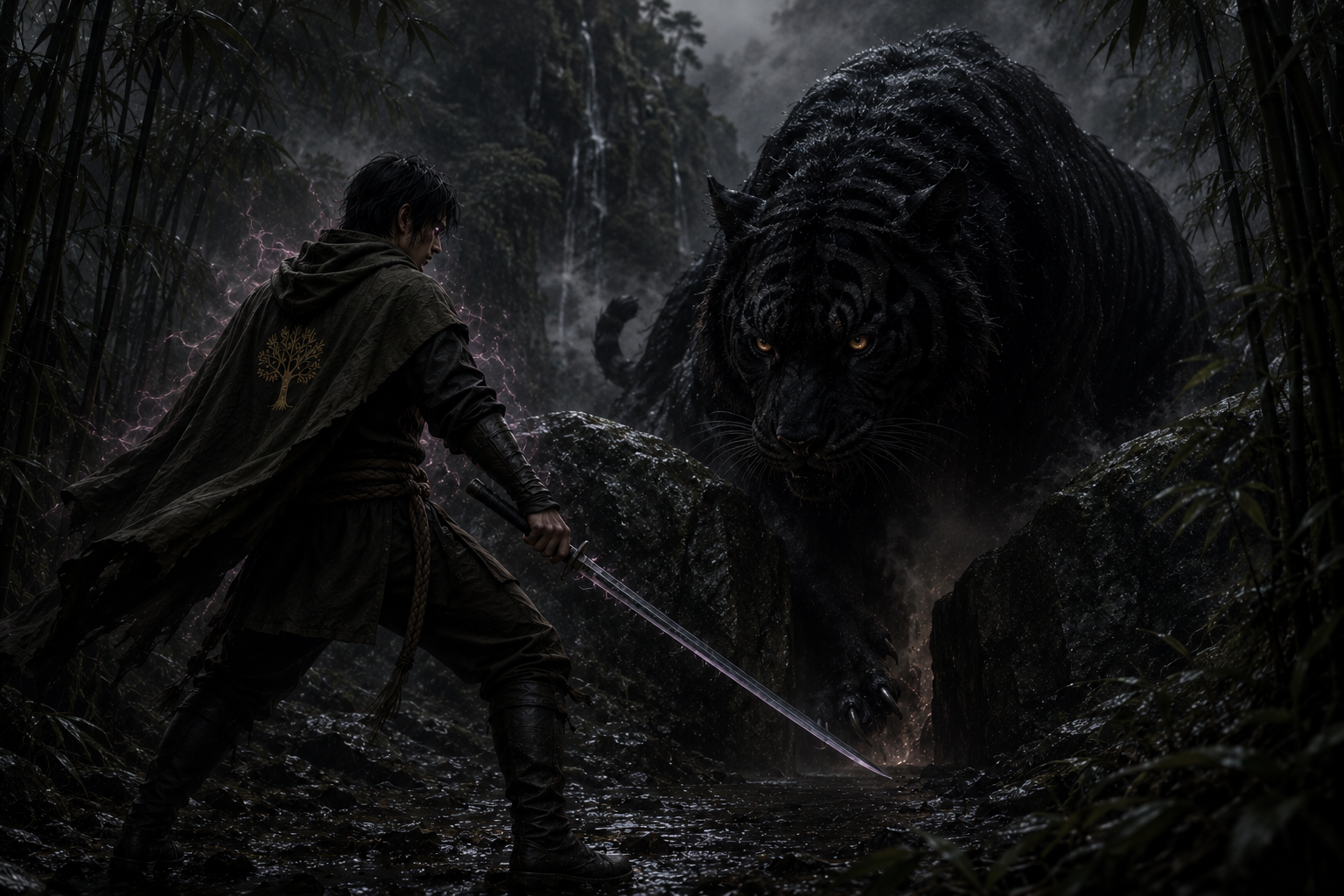
And in front of it, the beast.
It was no tiger.
Too large.
Too quiet.
Its black fur swallowed light. The stripes appeared only when the mist shifted, shadow within shadow. Its right forepaw sank half a finger-width deeper into the ground.
The beast turned its amber eyes toward him.
It did not growl.
It did not bare its teeth.
It only measured him.
Wellington finished drawing his sword.
The fissure exhaled hot air.
Wellington took one step back.
That was enough. A new fissure, a passage beneath the trail, a beast guarding the opening, a marker displaced without the mark of a hand. Sandra needed to hear this before Diogo came down with his axe and the wrong certainty.
The beast attacked before he could turn.
Its black body crossed the distance without warning.
Wellington raised his sword. The paw struck the blade and drove his arms into his chest. The impact hurled him into the bamboo grove. Two stalks snapped against his back.
He rolled before the second strike.
The claws gouged the stone where his head had been.
Wellington saw the deep furrows.
“Right. Don’t block.”
The beast wheeled faster than anything that size should have.
Wellington kicked a stone at its muzzle.
The stone burst in the air before touching it.
Not even stone could get through.
This was more than tough hide.
The Rose Aura thickened around him. The bamboo grove trembled, and the beast hesitated for a fraction too brief for any ordinary man to exploit.
Wellington exploited it.
He stepped into that fraction and slashed the right shoulder.
The blade opened the black fur and drew dark blood.
Not much.
But enough to strike the ground.
The blood tried to flow back toward the fissure.
Wellington understood too late.
It was not only defending its body.
It was defending the opening.
The tail came from the side.
He ducked too late.
The blow struck his ribs and drove him to his knees. The air left his lungs. The trail dissolved into blur, mist, and pain.
The beast could have finished him.
It did not.
It stopped.
Watching.
Wellington breathed once.
Twice.
The dark cloth had torn open along his arm. The ragged fabric hung wet with blood, violet and red trying to become the same color in the shadows.
It did not fight like a predator.
It struck, measured, paused.
If he showed more, it would see more.
If he did not show enough, he would die there.
The beast advanced.
The right paw faltered again.
“You don’t fit right inside that body.”
The beast roared.
The sound shook the bamboo grove. Leaves fell. Birds scattered farther down the slope.
Good.
Kauã would hear.
The beast leaped.
Wellington dropped the sword with its edge facing up and stepped back.
The beast corrected itself in midair to avoid the blade. Its right paw landed off-axis.
Wellington moved beneath its jaw, snatched the sword back, and dragged the edge along the inside of its foreleg. He threaded a strand of Rose Aura into the cut.
The beast locked up.
Not from pain.
From interference.
Its right shoulder fell out of rhythm.
Wellington got clear before the bite.
Almost.
The teeth tore cloth and skin from his arm.
An ugly wound, but an ordinary one.
The fissure pulsed harder. Hot air struck Wellington’s back.
The beast used the same trick he had just used.
It shifted its weight left, feigned weakness on the right, and struck from his blind angle.
Wellington escaped only because he recognized his own lie inside its body.
The claws grazed his chest, but missed the bone.
He retreated three steps.
The beast planted its right paw.
Too firmly.
It rolled the shoulder once.
Twice.
Testing.
Correcting.
Learning.
Wellington felt the fight change hands.
Sandra had told him to read, not feed the enemy secrets.
He had read.
Now he needed to return.
Wellington grabbed a broken length of bamboo, ran Rose Aura through the fibers, and hurled it straight at the fissure.
The beast leaped to intercept it.
It did not protect its own chest.
It protected the opening.
Wellington ran. He cut two stalks out of his path and climbed the trail without looking back.
The beast did not pursue.
Worse.
Tak.
Tak.
Tak.
Wellington looked over his shoulder.
The beast stood before the fissure, beating its right paw against the ground.
In the same rhythm he had used to feign retreat before striking.
Tak.
Pause.
Tak.
Faster.
Cleaner.
Wellington ran uphill.
At the second marker, Kauã was already on the embankment, bow drawn.
He looked as though he had been born on that edge: dark against the wet grass, lean body, eyes far too alert, the small emblem on his shoulder nearly hidden by the bow strap. His gaze went straight to the blood.
“Yours?”
“Mine and its.”
“Did it follow?”
“No.”
“Then why are you running?”
Wellington passed him.
“Because it stayed behind to practice.”
Kauã stood still for one second.
Then he ran too.
In the square, Diogo saw them arrive and took hold of his axe.
He did not draw the weapon.
He took hold of it.
As though calling a part of his own body by name.
His clothes were heavier than the others’, dark and reinforced at the shoulders, with copper and deep-red stitching along the edges. They carried the weight of someone made to stand where the ground failed. The broad, well-used axe settled into his hand without looking carried.
It looked remembered.
“Who did this?”
“Put the axe away.”
“I asked who did this.”
Wellington laid the sword on the stone table.
The black blood was still moving along the blade, trying to run south.
Diogo stopped.
Alessandra arrived moments later.
She did not look first at the cut across Wellington’s chest. She looked at the direction the blood was trying to flow.
Then she went pale.
Sandra came out of the workshop.
She did not ask whether Wellington was all right.
She looked at his chest, his torn arm, the sword, and finally his face.
Her presence cut the air before her voice did. Cold violet, gray-violet, a silent blade, authority without noise.
“Report.”
“Fissure at the lower bend. A black beast guarding it. Tiger-like body, but larger. The third marker wasn’t carried here. It passed beneath the trail.”
Alessandra touched the table near the blood without touching the blood itself.
“It’s trying to go back.”
“I noticed.”
Diogo tightened his grip on the axe handle.
“We’re going down now.”
“No,” Wellington said.
“It tore you open.”
“And I opened it. That’s not the problem.”
“Then what is?”
“It learns too fast.”
Kauã added quietly:
“He said it stayed behind to practice.”
Sandra went still.
“Practicing what?”
Wellington pointed to his own ribs.
“My feigned retreat. My weight shift. Its response to an inside cut. I wounded the right paw, and it corrected. Then it feigned the same weakness to draw me in.”
Diogo lost a little of his anger.
Only a little.
“An animal did that?”
“It’s not an animal.”
Alessandra looked south.
“It’s probing us.”
At last, Sandra picked up Wellington’s sword.
The black blood tried to climb the metal toward her hand.
A green glow kindled around Sandra’s fingers.
It was not large.
It did not need to be.
The blood stopped.
It did not retreat.
It stopped.
As though it, too, were watching.
Sandra’s expression hardened.
“Diogo, no one goes down without my order. Kauã, close the lateral routes. Alessandra, I want to know whether there is another passage beneath the village. Wellington...”
He looked at her.
“You’re going to sit down before you fall.”
“I’m fine.”
“Don’t answer me with false courage.”
Diogo let out a short laugh.
Wellington sat.
His posture still tried to preserve its dignity.
His body disagreed in blood.
Sandra kept her eyes on the blood.
Far below, too far for ordinary people to hear, something struck stone against stone.
Tak.
Tak.
Tak.
The same rhythm.
This time, Diogo heard it.
The entire square fell silent.
Wellington said what no one wanted to say:
“It didn’t come up to hunt.”
The blood on the sword trembled.
“It came up to study us.”