Chapter 2: No one took the short trail that morning

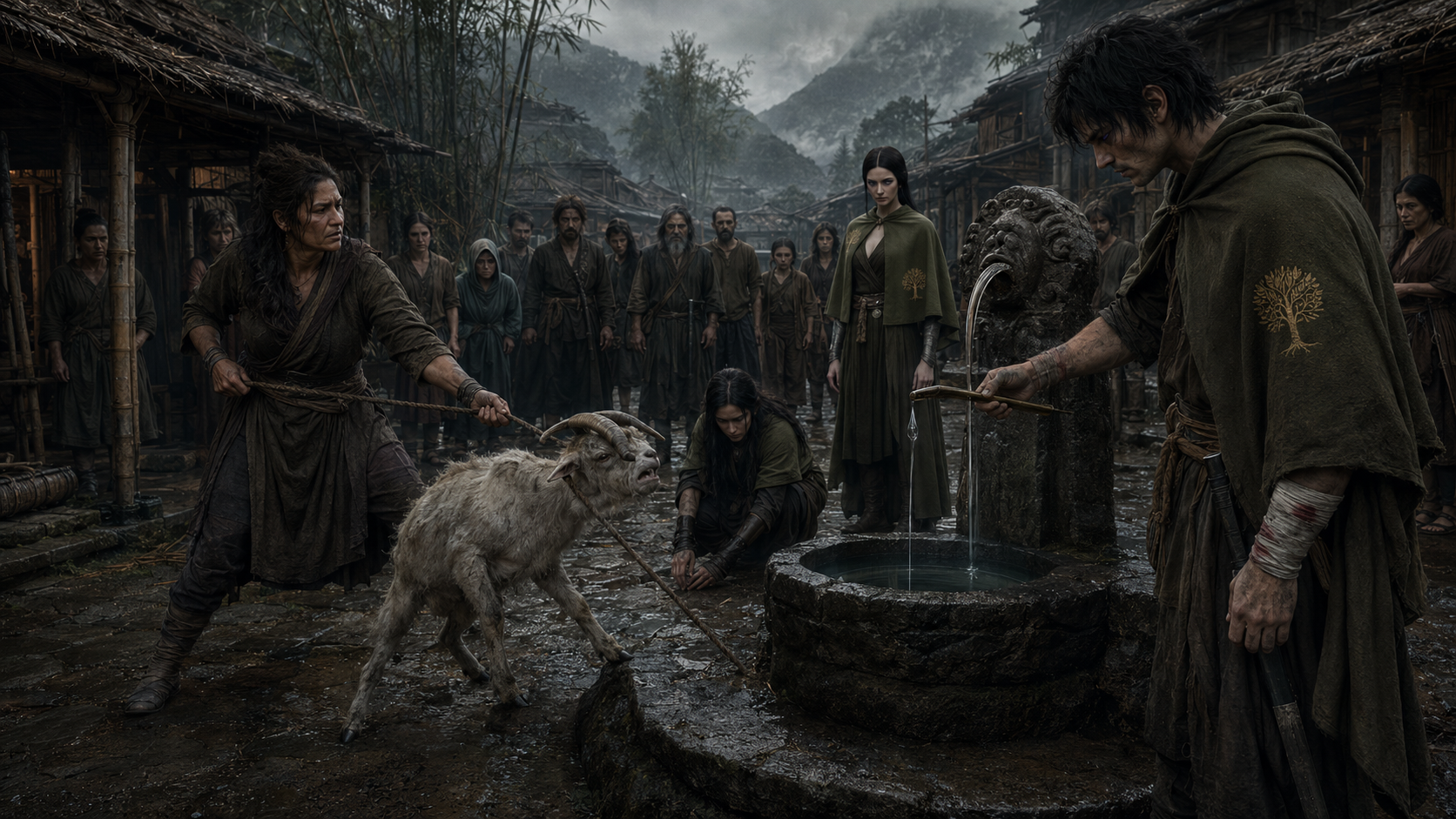
No one took the short trail that morning.
Sandra did not announce danger. She simply tied a rope between two posts, drove a sliver of bamboo into the ground, and said:
“No one goes past this point.”
The villagers obeyed before they asked why. The trail was still there, open through the same brush, and the third marker was still missing in the south. Even so, beyond the rope, that stretch of the Mountain no longer belonged to routine.
A woman carrying a basket of roots stopped at the barrier.
“Sandra, I need to go down to gather.”
Sandra did not even turn her head.
“You need to come back alive too.”
The woman closed her mouth.
Diogo stood beside the rope, axe across his back, looking as if he would rather have been the barrier himself.
“I could stay down there.”
“No.”
“Just to keep watch.”
“You don’t keep watch. You issue challenges.”
“If that thing comes up, someone has to hold it back.”
Sandra tightened the knot until one of her fingers went pale.
“If that thing comes up, I want to know before it sees you.”
Diogo looked south and did not answer. For him, that cost more than a blow would have.
Wellington watched from the stone table, sitting because Sandra had ordered him to, not because his body agreed. His arm was bandaged. His rib bit whenever he drew a deep breath, and the cut across his chest burned less than the shame of sitting still.
His sword remained on the table. Around the blade, Heren had arranged three stones, a jar of water from the fountain, two slender needles, glowing charcoal, and the strip of bamboo from the marker.
The old smith did not begin with the blood. He began with the wood.
“This wasn’t pulled out.”
Wellington tilted his head.
“I saw the hole. It looked as though the marker had sunk.”
“Sinking leaves pressure. Stone scrapes. Roots complain.”
Heren turned the marker’s clean end toward the light.
“Wood doesn’t pass through earth without carrying some earth with it.”
Alessandra stood on the other side of the table. Her light combat clothes, gray and dark olive green, looked simple until the light caught the small olive-tree emblem on her sash. Her fingers stopped before touching the bamboo.
“Then it didn’t pass through the soil.”
“It passed through space,” Heren said.
Wellington looked toward the square. The words made no noise, but they changed the air. Near the storehouse, Joel pretended not to have heard—and pretended badly.
Kauã appeared crouched on the workshop’s low roof, his bow laid across his legs. No one had seen him climb up.
“There’s wind at the fountain.”
Sandra looked up.
“Since when?”
“Since before the rope.”
“And you’re only telling me now?”
Kauã pointed south.
“I was watching to see if it came from there.”
Diogo snorted.
“Did it?”
Kauã climbed down from the roof without hurry.
“No.”
The answer left a worse question in its place.
Wellington tried to stand. Sandra kept looking at Kauã.
“Sit.”
“I’m only going as far as the fountain.”
“You’ll go when you can breathe without lying.”
“I am breathing.”
“You’re lying too.”
Diogo let out a short laugh. Wellington turned to him.
“You’re enjoying this too much.”
“I’m making the most of it while it lasts.”
“Put away the axe.”
“Mind the rib.”
Sandra tapped two fingers against the table. It was not loud, but it was enough.
Heren picked up one of the needles, heated the tip, and brought it close to the dried blood on the blade. The blood did not smoke or burn. It merely darkened, as if something inside it had awakened.
Then it moved.
An almost invisible thread pulled toward the sword’s edge.
South.
Joel dropped a sack of grain. No one laughed.
Heren drew the needle away.
“Ordinary blood recoils from fire. This ignores it.”
“It wants to go back,” Alessandra said.
“It doesn’t want,” Wellington corrected quietly.
She looked at him. Wellington breathed slowly, so his rib would not reveal everything.
“Wanting is for beasts. This is obeying.”
The square seemed smaller.
Heren took the jar and let one drop of water fall near the blood. The drop did not spread. It stayed still for an instant, then pulled in the same direction.
South.
Sandra closed her hand.
“The fountain too?”
Heren wet a finger, smelled it, touched it to the tip of his tongue, and spat on the ground.
“Normal water.”
“Normal water doesn’t do that.”
“I said the water was normal. I said nothing about its path.”
Alessandra stepped away from the table.
“The water may be clean and still be getting called from below.”
Wellington lowered his eyes to the square. Stone. Packed earth. Wheel tracks. Children’s footprints. Old ash near the workshop. Everything looked the same, and that was the problem. When something looked wrong, the village knew how to be afraid. When everything looked the same, people went on living over it.
Marta came down the fountain road, leading a goat by a rope. The animal strained backward so hard that its hooves scored the earth.
“Sandra.”
Her voice was not loud. It was worse.
Sandra crossed the square.
“Is she hurt?”
“No. But she won’t drink.”
Diogo turned.
“Goats balk sometimes.”
Marta gave him a look of dry anger.
“This goat walks into rain, mud, loose stone, and the neighbors’ yards. She doesn’t balk out of fussiness.”
The animal tried to retreat again. Kauã stepped out of the workshop’s shadow and shifted half a step to the right.
Wellington noticed the movement before he understood it. He followed Kauã’s gaze and saw that the goat’s rope was not stretched backward. It slanted down, as though the animal were not trying to escape the fountain, but something beneath it.
Alessandra understood at the same instant.
“It isn’t a smell.”
Marta tightened her grip on the rope.
“What?”
Alessandra approached the goat without touching her. She knelt beside a front hoof, studied the earth, then looked at the water running from the trough.
“If it were a smell, she would turn her head. If it were the taste, she would drink and spit it out. She never came close.”
Wellington stood despite the pain. This time, Sandra allowed it—for two steps.
He approached slowly. Water fell from the stone spout as it always had, but it made no song when it struck the basin, sent up no splash, did nothing to break the silence.
Soundless water was worse than moving blood. Strange blood could already be treated as an enemy. Water was home.
Wellington reached out. Sandra caught his wrist before he could touch it.
“No.”
“I need to feel it.”
“You need to stop treating your body like a public tool.”
“Mother…”
“Wellington.”
She said his name in full. He stopped.
Heren came up behind them carrying a thin strip of bamboo, marked in charcoal with the olive-tree emblem.
“Use this.”
It was a testing tool, not a weapon. Wellington took it and touched its tip to the fountain’s surface.
For an instant, nothing happened. Then water climbed the grain—not soaking into it, but advancing as though someone were sucking it up through the bamboo.
Marta dropped the rope. The goat fled three steps and hid behind Diogo. He made no joke.
Wellington pulled the strip back. The water did not drip. It clung to the tip, forming a drop stretched too long, pointing south.
Kauã spoke first:
“There’s another passage.”
Alessandra looked at the fountain, then the table, then the rope closing off the trail.
“Or the same passage is larger than it seems.”
Sandra swept her gaze over the square. She was not watching people; she was counting losses. Fountain. Corral. Trail. Children. Storehouse. Workshop. South. North.
When Sandra thought that way, the village changed before it ever heard the order.
“Joel.”
The storekeeper straightened his back.
“Yes.”
“Lock the water stores. No one draws from the barrels unless you see them do it.”
“The barrels will last two days.”
“Then now we have two days.”
He swallowed hard.
“And after that?”
“After that, we’ll still be alive to discuss it.”
Sandra turned to Marta.
“Take the animals to the upper yard. None of them stay near the fountain.”
“All of them?”
“All of them.”
Marta looked at the goat, then at the silent water.
“My yard is a warning now?”
“It is,” Sandra answered more softly.
Marta did not like it, but she pulled the goat along.
Davi appeared behind her, holding a length of rope and trying to look smaller than he was. Wellington noticed too late. Sandra saw him at once.
“Davi.”
The boy froze.
“I only came to help.”
“Where did you get that?”
Davi looked at his own hand. The rope was thin, old, and damp. It had three short knots and one long knot.
Wellington felt his rib disappear inside a different pain. Kauã was already beside the boy.
“Where did it come from?”
Davi squeezed the rope.
“The trough.”
“Which trough?” Sandra asked.
He pointed toward the corral.
“The one that appeared with the marker.”
Diogo took one step south. Sandra did not even need to speak; Kauã moved into the space before him. He did not push. He simply chose an angle that would force Diogo to go through him if he wanted to continue.
“Move.”
“No.”
“Kauã.”
“Sandra said no one goes down.”
“This is in the corral.”
“It’s underneath.”
The words struck everyone.
Davi began to cry without making a scene. His face reddened, his eyes filled, and he seemed to understand too late that playing with the wrong thing did not end in a scolding. It ended in fear on an adult’s face.
Alessandra knelt in front of him.
“Did you hear anything when you picked up the rope?”
Davi shook his head, then stopped halfway through the gesture.
Sandra lowered her voice.
“Davi.”
He looked at Wellington, not at her.
“I heard it under the trough first.”
“Heard what first?” Wellington asked.
The boy squeezed the rope until his fingers went white.
“Tak.”
No one moved. The water kept falling without sound.
“Then the fountain answered,” Davi finished between two broken breaths.
Heren took the rope with care. He did not pull; he waited for the boy to let go.
It was too clean, like the marker. No mud. No straw. No smell of the corral.
Heren brought it close to the drop clinging to the bamboo. The drop stretched, and the rope trembled.
Tak.
The sound came softly, but not from the rope.
From the ground.
Diogo gripped the axe with both hands.
“Sandra.”
“No.”
“It’s under the village.”
“Which is why you aren’t going to strike blindly.”
“And if it comes up?”
Sandra held his gaze.
“Then you stand where I tell you and hold when it is time to hold.”
Diogo locked his jaw. For him, obeying sometimes looked like taking a beating without being allowed to hit back.
Sandra walked over. She did not touch his face or embrace him. She simply adjusted the axe strap across his back, too firmly for affection, too carefully to be only an order.
“If you go down now, it learns you too.”
Diogo’s anger did not leave. It merely changed places.
“Where do I stand?”
“In the square.”
“Is that punishment?”
“A wall.”
He breathed through his nose and accepted, because Sandra had used the right word.
Wellington looked at the fountain again. The water’s silence had already contaminated everything: conversations had grown quieter, doors stood wider, and children stayed close to adult skirts and legs.
Without anyone needing to write it down, the village had learned a rule: never trust the path below.
Alessandra rose. Between her and Heren were the rope and the drop trapped on the bamboo.
“Two things are happening.”
Sandra turned.
“Go on.”
“The fissure calls what belongs to it: blood, water, perhaps marked wood. At the same time, the village is being measured through repetition.”
Wellington looked at her.
“Rhythm.”
“Rhythm, route, and response.”
Kauã looked toward the corral.
“It began in the south, appeared in the north, answered at the fountain.”
“Then the next point doesn’t have to be nearby,” Wellington concluded.
The idea had barely settled over the square when Sandra cut it off before it could become panic.
“Kauã, mark the roof, the fountain, the corral, and the storehouse. I want a clear line of sight between all four.”
“I’ve already started.”
“Start again and show me where you failed.”
Kauã took the rebuke without blinking.
“Yes.”
“Heren, take the rope, the bamboo, and the sword to the workshop. Nothing touches the earth.”
“And if it does?”
“Call me before you lie and say you controlled it.”
Heren made a sound through his nose that almost resembled a laugh.
“Fair.”
“Joel, no one stays alone in the storehouse.”
Joel stared at his own building as if it had changed owners.
“Not even me?”
“Especially not you.”
Sandra turned to Wellington. He already knew.
“I stay seated.”
“No. You stay with me.”
That landed worse.
“Why?”
“Because you’ve heard the rhythm once. If it changes, I want your face close enough to give it away before your mouth invents courage.”
Diogo laughed quietly. Wellington pointed at him.
“A wall doesn’t laugh.”
“Bait doesn’t give orders.”
“I’m not bait.”
Sandra looked at them, and the argument died there.
Davi still looked too small in the middle of the square. Marta came back, took him by the shoulder, and pulled him close.
“He stays with me.”
Sandra nodded.
“And away from troughs, fountains, ropes, bells, holes, markers, and anything else that seems to be calling.”
Davi wiped his nose on his arm.
“Can I stay away from everything?”
Marta answered before Sandra could:
“Today, you can.”
The first knock came when Heren lifted the sword from the table.
Tak.
Everyone heard it. Heren froze.
The second came from the fountain.
Tak.
The third came from the corral.
Tak.
They were not echoes. They were answers, one after another.
South. Fountain. Corral.
The Rose Aura prickled beneath Wellington’s skin, not as strength, but as warning. For an instant, the entire square became too sharply defined: Diogo’s hand on the axe, Sandra’s gaze jumping between points, Kauã already searching for height, Alessandra measuring the interval between knocks, Davi holding back his tears.
Then came the fourth.
Tak.
From the storehouse.
Joel went white.
Sandra did not run. To run would be to admit that the village had lost its center. She simply drew the short blade at her waist, clean and green beneath the morning light.
“No one stays alone.”
The fountain water began to make sound again. It brought no relief.
Along with the sound of the water, something answered far below, beneath the square, in the same rhythm.
Tak.
Tak.
Tak.
Closer.