Chapter 3 — The Weight That Doesn’t Add Up

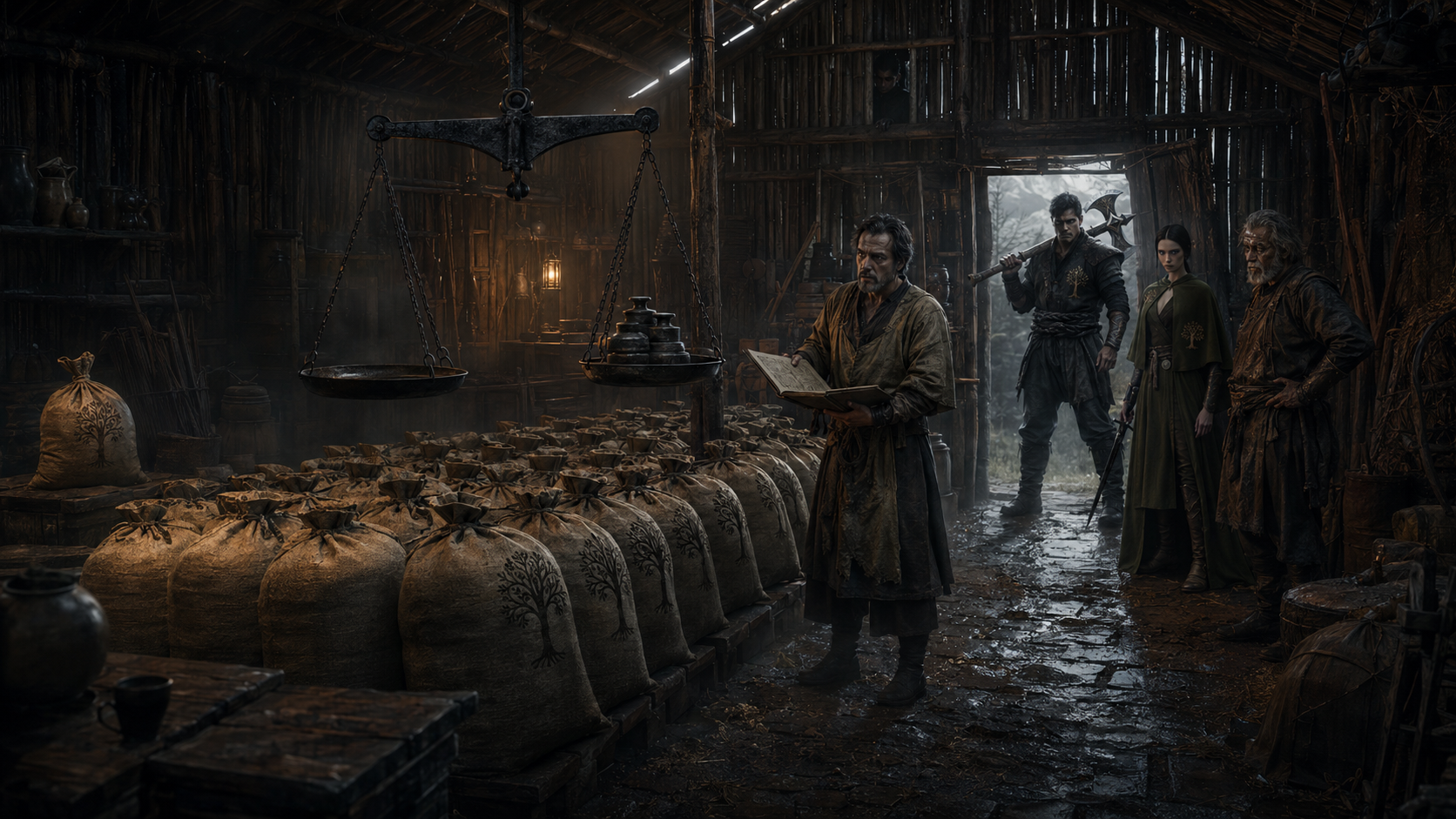
Joel discovered that he did not know how to open his own storehouse with people watching.
The key was in his hand. The door was in front of him. Sandra was behind him. That should have been enough, but his finger missed the lock twice.
“Joel,” Sandra said.
It was not a rebuke. It was an order for him to remain useful.
Joel breathed, fitted the key into the lock, and turned it. The door opened inward.
The storehouse smelled of dry corn, leather, salt, old wood, and recent fear. Nothing leapt, growled, or emerged from the dark. That was precisely why Diogo tightened his hand around the axe handle.
“I hate it when things look normal.”
“You hate it when they look like anything,” Wellington replied.
He remained leaning against a veranda post, his arm bandaged and his short combat tunic poorly fastened over the cut in his chest.
“You go in last,” Sandra warned.
“I’m fine.”
“You breathe crooked.”
“It’s style.”
“It’s your rib.”
Diogo almost laughed. One look from Sandra was enough to make him reconsider.
Kauã had already vanished from the door. One instant he was in the yard; the next, he was crouched beneath the storehouse eaves, between shadow and tile, watching what the others could not see.
Alessandra did not enter either. She stopped at the threshold. The wind in the square stirred the light fabric of her clothes, but the inside of the storehouse did not answer. No dust rose. No smell escaped.
“The door opened, but the air didn’t come out.”
Heren studied the gap, a strip of leather coiled in one hand and two needles pinned to his sleeve.
“A closed place always spits something out when it opens.”
Joel swallowed.
“This one spat yesterday.”
Sandra turned to him.
“What?”
Joel looked at the others. Saying it aloud seemed capable of making it larger.
“Before the blood and the fountain, I opened up to get salt. I smelled cold rain. Stone coming down after a storm high above.”
Wellington straightened despite his rib.
“And you didn’t call anyone?”
Joel flushed.
“It was a smell.”
“Joel.”
“It was only a smell.”
Sandra did not raise her voice.
“From today on, ‘only a smell’ goes on the list.”
He nodded quickly.
Sandra drew the short blade at her waist. The green glow around her fingers did not kindle in full; it merely touched the metal, reminding the weapon who commanded it.
“Diogo, the door.”
“Finally.”
“The door, not the front.”
His satisfaction died. Diogo took his place in the entrance, broad enough to make the storehouse look as though it had gained a new wall. The axe stayed on his back. His hand did not.
Sandra entered first. Heren followed, studying the floor. Alessandra remained at the boundary, and Wellington obeyed the order to go in last because disobeying on foot hurt more than disobeying while seated.
Inside, the place was simple: sacks of grain on the left; barrels of water and salt on the right; tools on the wall; rope, leather, baskets, jars, scale weights, and, on the table, Joel’s ledger of everything that came and went.
The life of the entire village fit inside in the shape of stacked things. If the fountain was home, the storehouse was breath. Without it, the village did not fight, plant, or wait. It merely counted down the end more slowly.
Joel went to the table and opened the ledger.
“Yesterday afternoon there were forty sacks of dry grain, twelve barrels of water, six of coarse salt, three baskets of roots, treated leather, small tools, rope, saddle patches, oil, candles…”
“What changed?” Sandra cut in.
Joel looked at the sacks, at the book, then back at the sacks. The color left his face.
“No.”
Wellington followed his gaze. Four rows of ten sacks.
Forty.
Too perfect.
“Speak,” Sandra ordered.
Joel turned a page in a hurry. His hand trembled; his eyes did not. Storehouse people could tremble on the outside. Inside, they kept counting.
“I leave nine in the first row so the cart can pass. With ten, it scrapes the corner. I never leave ten.”
Diogo studied the stacks.
“Someone tidied up.”
“No one tidies my storehouse.”
The offense in Joel’s voice almost turned the impossible into an ordinary problem.
Almost.
Alessandra crouched at the threshold.
“No drag marks.”
Heren went to the first row and ran two fingers beneath the nearest sack. They came away clean.
“No dust.”
Wellington recognized the pattern.
“Like the marker.”
Joel pressed the ledger to his chest.
“Sacks don’t walk.”
Kauã’s voice came through the gap between tile and wall:
“That one did.”
He was pointing to the south corner at the back of the storehouse.
Diogo took one step forward. He stopped before Sandra needed to order him.
Heren approached the last sack. At first glance, it was identical to the others: the same coarse cloth, the same knot, the same charcoal mark on its side. Yet it was too clean. The storehouse held dust, flour, straw, old rat scratches, and the smell of the hands that fed the village. That sack looked as though it had been set there after the world learned how to dirty things.
Heren did not touch it.
“Joel.”
“It isn’t mine.”
The answer came at once. Under Sandra’s gaze, Joel opened the ledger and showed them a page.
“I mark every sack. Even when it comes from a neighbor, when it’s returned, or when it comes from the Two Hundred Fund. If it doesn’t have my mark at the mouth, it doesn’t come in.”
Heren tilted his head.
“There’s a mark on the side.”
“Anyone can copy the side. Not the mouth.”
Joel pointed to the binding. Three short turns and one long—the same pattern as the marker and the rope Davi had found.
Diogo exhaled hard.
“Can I break it now?”
“No,” Sandra, Wellington, and Alessandra answered at the same time.
He scowled.
“Wonderful. A united family.”
Alessandra finally crossed the threshold, but she did not go to the sack. She went to Joel’s scale, suspended from a low beam by a thin chain. One of the iron pans hung lower.
Empty.
She touched the chain with the tip of one nail. The empty pan sank a little farther.
Joel stepped forward.
“That doesn’t happen.”
“It did,” Diogo said.
“I know. I’m telling you it doesn’t.”
The chain clicked.
Tak.
The empty pan dropped another finger’s width. Heren swept Alessandra back with one arm, Sandra raised her blade, and the Rose Aura rose on instinct beneath Wellington’s skin.
Sandra noticed.
“Lower it.”
“I haven’t even done anything.”
“Yet.”
He held the aura close to his body. The scale stopped.
Alessandra shifted her gaze between the empty pan and the sack in the south corner.
“It isn’t weighing the pan.”
Wellington followed the connection: pan, chain, beam, floor, sack, south.
“It’s weighing what’s connected.”
Heren took an iron weight from the table and placed it in the higher pan. Nothing. He added another, then a third. The empty side remained below.
Joel wiped a hand across his face.
“That weighs twenty measures.”
“It isn’t accepting iron,” Heren said.
“Then what does it accept?” Diogo asked.
Wellington looked at his own sword, still in the smith’s care. He disliked the answer before he formed it.
“Blood.”
Sandra turned her head toward him.
“No.”
“I didn’t offer mine.”
“You thought about it.”
“Is thinking still allowed?”
“Near that thing, I don’t trust even that.”
Heren picked up a sliver of bamboo marked in charcoal and touched it to the higher pan. The scale moved; the empty pan rose the width of a fingernail. When he laid the whole sliver down, the two sides balanced.
Joel whispered:
“Bamboo weighs more than iron now?”
Alessandra did not take her eyes from the chain.
“It isn’t weight. It’s belonging.”
Wellington looked at the clean sack.
“It’s trying to look like one of ours.”
The door creaked. Diogo brought the axe forward before thinking, but outside there was only the square, the morning light, and Marta leading two goats away from the fountain while pretending not to look at the storehouse.
Kauã spoke from the roof:
“North is clear.”
Sandra lifted her face.
“South?”
He took too long, and the delay moved through everyone.
“South is quiet.”
“Wrong quiet?”
“Waiting quiet.”
The scale struck again.
Tak.
The sliver jumped from the pan and fell to the packed earth. Heren swore under his breath and bent to retrieve it.
“Don’t touch it,” Sandra ordered.
The sliver lay still for two seconds. Then its tip darkened—not like burning wood, but like soaked fiber drawing night up from inside the ground.
Alessandra stepped back half a pace.
“That didn’t come from the sack.”
Wellington studied the earth. Beneath the sliver, it was not cracked. It was smooth—as smooth as the new trail, the base of the marker, and the clean rope.
The Mountain did not open holes. It created clean paths beneath things.
Diogo followed his gaze.
“There’s a passage under the storehouse.”
“Or the storehouse has become a passage,” Wellington said.
Joel dropped onto the bench behind him. The wood groaned.
“Don’t say that.”
No one promised it was a lie.
Sandra walked toward the south corner. Diogo followed by half a step.
“The door,” she reminded him.
He returned to the entrance with obedient hatred.
Standing before the sack, Sandra did not touch the cloth. She only brought her blade close. The surface caved inward just enough to give the impression that something inside had moved away from the edge.
Joel rose so fast that he knocked over the bench.
“Grain doesn’t do that.”
Heren looped the strip of leather around the sack without touching it.
“What if I bind it and pull?”
“It learns the pull,” Wellington answered.
The smith stopped. Sandra looked at her son.
“Explain.”
“The beast didn’t repeat only the blow. It repeated the intention: false retreat, weight, pause. This is the same. It didn’t copy a sack. It copied entry, mark, arrangement. Now it’s waiting for us to teach it the next gesture.”
Even Diogo understood the size of the silence that followed.
“So no one moves it?”
“We move it,” Sandra decided. “But without teaching it.”
She turned to Alessandra.
“What is it waiting for?”
Alessandra closed her eyes for an instant. When she opened them again, she did not look at the sack, but at Joel.
“For him to defend his own storehouse.”
Joel blinked.
“Me?”
“If someone puts something strange in a person’s home, they remove it. If the count changes, they correct it.”
Wellington felt the thought lock into place.
“It wants an owner’s response.”
Joel stepped back.
“I’m not a cultivator.”
Sandra turned to him.
“Today, that’s an advantage.”
“How is that an advantage?”
“Because it’s studying us,” Wellington explained. “Not you.”
Heren offered Joel a thin bamboo rod.
“Push the sack.”
The man held it like a spear against a war.
“That’s all?”
“That’s all.”
Sandra stood beside him.
“If it moves wrong, I cut.”
Joel looked at her.
“The sack or me?”
“Decide not to find out.”
Diogo’s small smile helped keep Joel from fainting.
He pressed the tip of the bamboo to the cloth and pushed. The sack did not move. Joel used more force; the rod bent.
“It weighs more than it should.”
Wellington saw the empty pan descend.
“Stop.”
Joel obeyed. So did the scale.
Sandra narrowed her eyes.
“Again. Slowly.”
Joel pushed, and the pan followed his effort.
Alessandra spoke softly:
“It’s learning ordinary strength.”
“Joel, let go,” Sandra ordered.
He opened his hand. The rod remained stuck to the cloth on its own. Its tip sank a little deeper, then was returned.
Tak.
The bamboo fell intact, but four scratches had appeared near the tip: three short and one long.
Kauã climbed down from the roof and appeared in the doorway without a sound. Diogo nearly struck him on reflex.
“Don’t do that.”
“There’s another mark on the roof.”
Sandra did not move.
“Where?”
“Above the sack.”
Heren raised his eyes. Four thin cuts marked a beam that had been clean before.
Joel let out a breathless laugh.
“It marked my ceiling?”
Wellington compared the beam and the sack.
“No. It marked the height.”
Alessandra’s face hardened.
“It isn’t only passing underneath.”
Heren examined floor, beam, and walls.
“It’s measuring the entire space.”
Diogo abandoned the door. This time, Sandra allowed it. He stopped in the aisle between the sack and the others, axe in hand, his shoulders taking up what little room remained.
“Enough.”
It was not a shout. It was a wall.
The sack caved inward again, as if it had heard—and liked it.
Sandra raised her blade.
“Diogo.”
“I’m not going to hit it.”
“Then what are you doing?”
He did not take his eyes from the sack.
“Being big.”
Wellington almost laughed, but the urge died when it worked. The sack drew back a finger’s width, and the scale rose.
Kauã saw it first.
“It responds to presence.”
“No,” Alessandra corrected. “It responds to limits.”
Sandra lowered her blade a little without relaxing.
“Joel. Does that sack stay here?”
He looked at the south corner, the marked ceiling, the smooth floor, the scale, and Diogo standing between an ordinary man and the impossible.
“No.”
His voice failed on the first sound, then steadied.
“It doesn’t stay.”
Sandra nodded.
“Then say it.”
Joel breathed and squared his shoulders.
“This isn’t mine.”
The sack trembled.
Joel stepped forward, still protected by Diogo.
“It didn’t enter through my ledger. It didn’t pass through my hand. It does not feed my people.”
The mark on the ceiling darkened.
Joel pressed the book to his chest.
“And it does not belong in this storehouse.”
The last word struck harder than it should have. The sack collapsed and began to lose its shape.
Heren lunged with the leather and lassoed the cloth before it could sink. Diogo pinned the bottom with the axe handle, without cutting. Kauã appeared in the south corner and drove an arrow into the floor, trapping the mouth of the sack by its fold. Alessandra pulled Joel back.
Sandra cut the air, not the sack.
A green line passed between cloth and ground. The storehouse cracked.
Tak.
The sound came from every side. Barrels, beams, scale, and floor answered. Beneath it all, something larger returned the knocks, slowly.
Tak.
Tak.
Tak.
The Mountain had heard Joel say no. And something beneath it had found that interesting.
The sack stopped collapsing. The mark on the beam disappeared. The bamboo rod split in two.
Joel dropped back onto the bench.
“I want another job.”
Diogo looked at him.
“There isn’t one.”
“I know.”
“Then get up.”
Joel got up. Slowly, but he got up.
Sandra sheathed her blade only halfway.
“Heren, that sack goes to the high stone. It does not touch earth. Kauã, route above ground. Diogo, carry it.”
Diogo stared at the sack.
“Now I can?”
“Carrying isn’t hitting.”
“For me, that’s almost sad.”
Wellington stepped forward. Sandra pointed without looking.
“Not you.”
“I didn’t even say anything.”
“You breathed with intent.”
Alessandra picked Joel’s ledger up from the floor and handed it back.
“Record it.”
“What?”
She looked at the empty south corner.
“That today, something came in that wasn’t stock.”
Joel dipped the pen. His hand was still trembling, but he wrote. When he finished, the ink pulled itself to the end of the line and formed four strokes.
Three short.
One long.
This time, no one spoke.
Outside, the fountain kept making sound, the animals remained restless, and the square stayed full of people pretending not to be waiting for an order.
Sandra closed the ledger with an open hand.
“From now on, nothing enters the village without name, hand, and witness.”
Wellington looked south. Bound by the leather, the sack released one last crack. Not a tak, but almost a voice trying to learn wood.
Diogo heard it.
“Did that try to speak?”
Wellington took a moment to answer. For a fraction too brief, he had understood the intention before the sound.
It was not a word.
Not yet.
It was practice.
He looked at Sandra.
“It’s learning where we keep food.”
The ink trembled beneath her hand.
“Now it will try to learn where we keep people.”