Chapter 10 — The Body Collects First
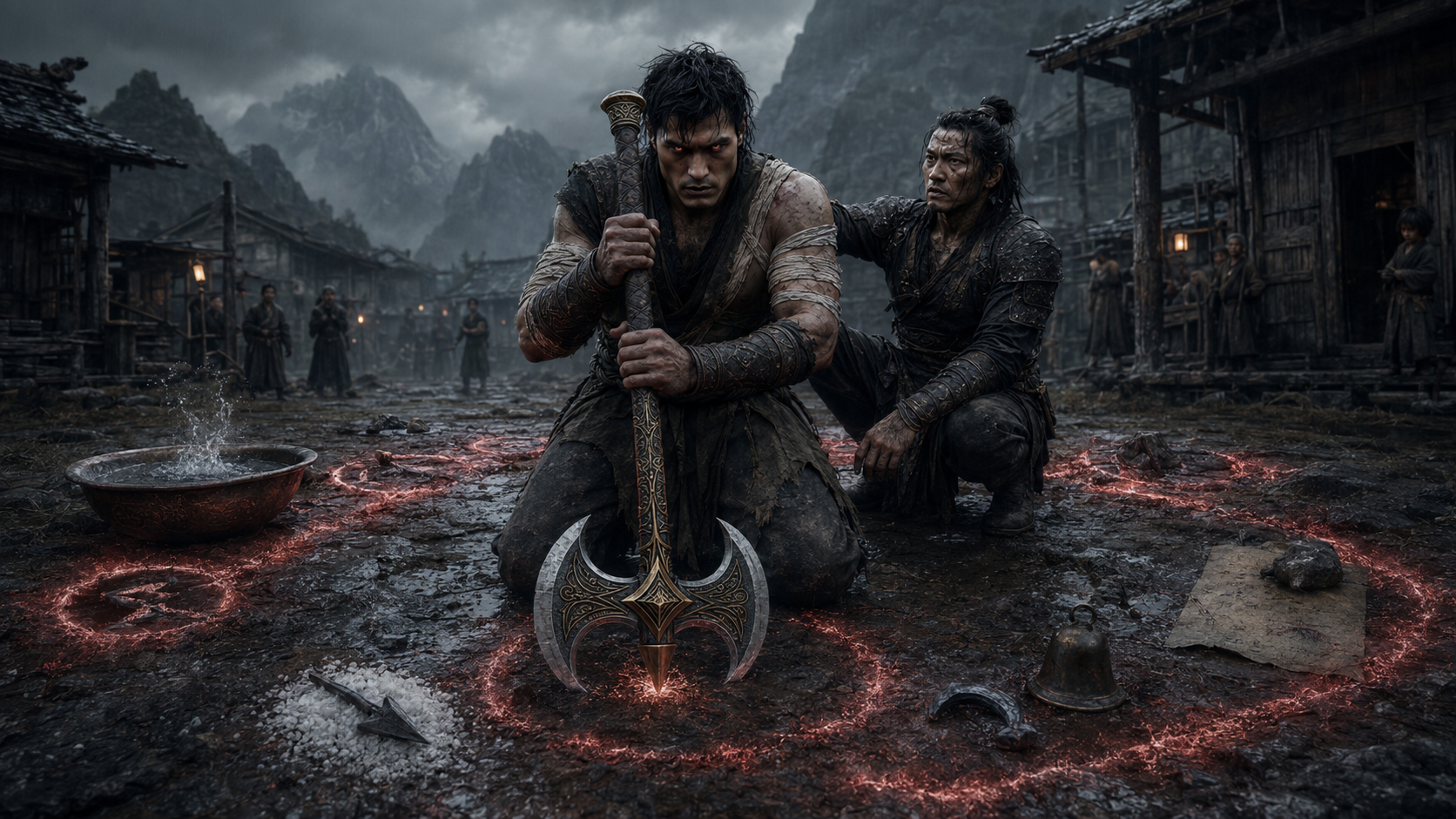
Diogo tried to lift the axe.
The axe did not rise.
That was worse than the pain.
He closed his fingers around the handle again. The blade dragged half a finger’s width through the dirt and stopped.
Kneeling beside him with a needle, cloth, and salt, Heren said:
“Pull again and I’ll sew your hand to the ground.”
“Sew fast.”
“I’m trying to stitch flesh, not saddle leather.”
Heren drove the needle in.
Diogo locked his jaw. He did not scream. His entire body shook anyway.
Sandra saw.
She said nothing.
When Sandra argued, there was still room to maneuver. When she only looked, she was counting what she had almost lost.
Riku remained beside the broken veranda, his arm bound in two loops of rope and one of Kauã’s arrows planted between his ankles. His face was swollen, one tooth was missing, but his eyes never left the lock of hair on the iron plate.
Iori.
Or whatever the Mountain had used to look like Iori.
Davi and the other children were inside the storehouse, behind Joel and Marta. The door stood open just far enough for Sandra to see them.
No one liked it open.
No one liked it closed.
Wellington watched the sealed fissure at the center of the courtyard. Alessandra held a basin of water; Kauã had returned to the roof. All four edges remained connected to the center.
Nilo came back from the north with ash up to his elbow.
“The bell fell, but it didn’t break.”
He opened his hand.
In his palm lay a curved shard of dark metal, marked on the inside.
“That came from the bell?” Heren asked.
“It did.”
“Bells don’t have flesh.”
The shard moved.
Barely.
Just enough to reveal the syllable.
Ta.
Takenaga.
Riku strained against the rope.
“Stay,” Diogo said.
“You can barely hold on to your own blood.”
Diogo tried to smile.
“I can still hold you.”
He leaned his weight on the axe.
His body came to collect.
The color drained from his skin, his chest seized, and his mouth filled with blood. Diogo vomited onto the ground.
Even Riku stopped.
Heren caught him before he fell.
“I warned you.”
Sandra crouched in front of her brother and took his face in one hand.
“Look at me.”
He did.
“You do not leave this courtyard. You do not stand without someone beside you.”
“Something is knocking beneath the square. A clan is being called by half a name. There’s a child in the storehouse.”
His voice failed on the last word.
Sandra took half a second.
“That’s why you stay.”
“That makes no sense.”
“It does. Just not the kind you wanted.”
The Crimson Forge ran in a fine line through the axe—the seepage of what Diogo had endured, not power freely given. His body charged interest: shoulder torn open, stitches pulling across his back, left hand lagging, and his right leg receiving orders after the rest of him.
For the first time, protecting someone meant not running toward the threatened place.
The water in the basin trembled twice. Paused. Trembled twice again.
Riku recognized it.
“Mizuhara. Two entrances, two exits.”
One drop rose at the center.
Mi.
Brina entered from the east, her clothes soaked to the knees. Sena came behind her, protected by a cracked blue barrier.
“The spring?” Alessandra asked.
“It isn’t where it was,” Sena replied.
Joel closed his eyes in the storehouse doorway.
“Springs don’t walk either.”
“This one did today,” Brina said.
The drop pulled toward the two women. Sena raised the barrier. The water struck it like a finger against wood.
Tak.
“It did that at the spring,” Sena said. “It called the surname first. Then the mistake.”
Riku stiffened.
“Iori?”
“Yuma Mizuhara. My barrier-sister. From my line. She should not have been on the Mountain.”
The protection around Sena’s arm dimmed for an instant.
Riku released his breath too early. It was not Iori.
The relief lasted until he understood what it meant to hear someone else’s mistake.
“It isn’t pulling only the people who were lost here,” Wellington said.
Alessandra tracked the drop.
“It’s pulling relationships.”
Kauã dropped from the roof with an arrowhead in his hand.
Dark iron. Heavy. The smell of a cold mine.
Heren took it with the tongs.
“Ishidoro.”
A mark emerged through the metal from the inside out.
Ishi.
The arrowhead sweated a drop. The water passed through the broken table, fell to the ground, and knocked.
Tak.
The fissure answered from below.
Tak.
The storehouse answered.
Tak.
Ta had come from the north. Mi trembled in the eastern water. Ishi dripped from the west. In the south, the blue thread still held Iori’s trace.
All four edges were delivering something to the center.
A child cried inside.
Sandra was already moving.
“Diogo holds the center. Heren stays with him. Riku too.”
Riku rose with the rope still around his arm.
“I’m not staying.”
Diogo tried to lift the axe. The blade did not leave the ground, but red leaked around the handle.
“Sit.”
Riku measured the failing body in front of him and realized Diogo did not need to stand to stop him.
He only needed to remain in the way.
Riku sat.
“We finish this later.”
Diogo rested his forehead against the handle.
“Get in line.”
Sandra entered the storehouse with Alessandra and Wellington.
The place smelled of salt, dry corn, and wax.
Joel kept the candles in a high box. Even so, one burned on the ground among the children.
No one had lit it.
The flame burned downward.
The wick stood on top; the light sank into the earth.
Marta held Davi against her body. He watched anyway.
Sandra stopped outside the children’s circle.
“Who saw it first?”
A girl raised her hand, crying.
“Lina did,” Joel said.
Sandra looked at her.
“Tell me.”
“I thought it was a firefly. It was under my foot. When I moved my foot, the candle came up.”
The ground around the flame was too smooth. Like the marker. Like the sack. Like the fissure.
Alessandra looked at Davi.
“Did you hear it?”
He nodded.
“Counting.”
“How high?” Sandra asked.
“It wasn’t numbers. It was places.”
The candle knocked.
Tak.
Davi pointed down.
“First trails. Then water. Food. Door. Bell. Name. Fight.”
Another knock.
“Now child.”
Marta pulled him hard against her.
“No.”
“It isn’t to take one,” Davi said. “It’s to know where one is.”
Sandra placed her blade between the flame and the children. The fire bent toward the metal like attention.
Alessandra crouched.
“Two layers. The candle isn’t lighting the storehouse. It’s lighting underneath it.”
A circle appeared in the earth. Inside it, strokes marked children, adults, door, wall, and candle box: the village in miniature, seen from below.
Joel stood by the door. Marta bent over the children. Sandra, Wellington, and Alessandra formed a half-circle. With every breath, the point marking Davi sank deeper.
Sandra cut through the drawing. It split and returned even faster.
“Don’t cut it the same way,” Alessandra said. “It learned the cut.”
Wellington threw salt around the candle.
The flame stopped like an animal hearing a footstep.
“It doesn’t like things that remember their owner,” Davi said.
Alessandra tore the last written page from Joel’s ledger.
“That was a record,” he protested.
“Now it’s proof.”
Sandra laid the page over the flame. The fire tried to enter, but found ink, weight, entry, exit, name, and the repeated touch of a human hand.
Outside, the axe struck.
Tak.
The flame shrank.
Wellington turned toward the door.
“Diogo?”
Heren shouted:
“He didn’t stand!”
Diogo answered hoarsely:
“But I heard.”
Sandra understood.
“Three strikes. Slowly.”
“If I die beating an axe while sitting down, I’ll come back to haunt you.”
“Strike.”
Tak.
The circle lost its door.
Tak.
It lost the wall. In the courtyard, Diogo’s breathing came ragged, and fresh blood spread through the bandage over his shoulder.
Tak.
The flame went out downward.
On the scorched page remained a map of the storehouse made from absence. Beneath Davi’s place was a single point.
It had not marked all the children.
Only him.
“Why?” Marta asked.
Davi clutched her clothes.
“Because I hear the counting.”
He answered like a child confessing to a broken bowl. There was no pride in it. Only the small certainty that this had already become part of him.
Sandra sheathed her blade halfway.
“Davi does not stay alone, not even to breathe.”
From the courtyard came the impact of flesh against wood.
Sandra went outside.
Riku stood with the rope at his feet. Diogo stood too, more or less: using the axe for support, white with sweat.
“I told you to stay,” Sandra said.
“He heard it,” Diogo replied.
“My name,” Riku said. “Under the courtyard.”
Four marks lay in the dry earth at the center: axe, water, iron, and bamboo.
Between them, a line was writing.
Ri.
Riku.
“Then open it,” he said.
“No,” Diogo replied.
“You’re going to fall.”
“Probably.”
“Then move.”
“No.”
Sandra faced her brother.
“You are not an endless wall. Today you’re a cracked brace. Stop pretending you’re still a fortress.”
Diogo opened his mouth.
He found no good answer.
Kauã spoke from the veranda.
“Movement in the north. Wrong patrol.”
Five shadows appeared at the gate in Nilo’s formation. Their spacing and silence were correct.
Too correct.
“My men are in the high north,” Nilo said.
The shadows took one step. The one in the middle moved late. Nilo’s bell hung from its hand.
Nilo recognized the way Tomás’s left shoulder sagged after a long march. The first shadow did it; the other four missed the formation by tiny distances.
“Call them by a mistake only they know,” Sandra ordered.
Nilo cupped his hands around his mouth.
“Rat lost his boot!”
The shadow on the left answered:
“Rat never had a boot.”
Nilo released his breath.
“It’s Tomás.”
“Wait,” Wellington said.
The middle shadow raised the bell.
Tak.
The sound came before the movement.
Wellington pulled Nilo away. The ground where he had stood sank a handspan.
Sandra cut the air between the gate and the shadows. The figure on the left remained human. The other four lost detail like wet ink.
Kauã fired. The arrow passed through the shadow with the bell, which fell upward and vanished into the mist.
Tomás dropped to his knees outside the gate.
There was dirt inside his mouth.
“Don’t let it count the fourth.”
“The fourth what?” Wellington asked.
Tomás opened his mouth. Three short strokes and one long marked his tongue.
He struck his forehead against the ground.
Tak.
The four shadows struck with him.
Tak.
In the east, the basin answered.
Tak.
In the west, the Ishidoro arrowhead.
Tak.
At the center, the earth.
Tak.
Five knocks.
Davi shouted from the storehouse:
“Now!”
The marks completed themselves at the same time.
Riku.
Mi.
Ta.
Ishi.
On Joel’s page, the point became Da.
Davi.
The syllable formed over the point marking the boy and began to thicken, as though name and place were the same thing.
Diogo struck with the axe. The Red Aura opened in a low circle and stopped the writing, but drove him to his knees.
The others answered before the Mountain could resume.
Alessandra covered Mi with the basin. Water climbed the copper rim and broke apart beneath the blue film.
Heren sealed Ishi inside a sack of salt. When the sack jumped, he pinned it between his knee and the earth like a bad piece from his workshop.
Kauã planted three arrows around Ta. The shard struck at every way out and found no route.
Wellington held the page against his chest while Da burned across the margin.
“This is a child. Not a map.”
Sandra reached Tomás.
He raised eyes that looked too normal.
“Sandra Oliveira.”
She stopped.
“Tomás doesn’t call me that.”
The mouth smiled.
“Then teach me.”
Sandra cut the shadow using his voice. A nearly transparent thread leaped from his mouth and tried to return. Kauã pinned it to a tree.
Nilo dragged Tomás through the gate. The four shapes withdrew into the mist like something that had already written down enough.
At the center, Riku held Diogo by the shoulder.
“Take your hand off me,” Diogo said.
“Fall on your own, then.”
His attempt at laughter became a cough.
Then blood.
Riku tightened his grip.
No one commented.
Sandra took in the state of every front: marked water; metal too alive to be metal; no certainty in the north; Tomás’s mouth used; Davi marked as the center point.
When she looked at Diogo, he answered:
“Bad.”
“Be specific.”
“Shoulder open. Back punctured. Neck cut. Left arm failing. Right leg late. Head making noise.”
“Lie down.”
“If I lie down, the center gets lighter.”
Riku looked at the mark bearing his name.
“He’s right.”
Alessandra approached the inscriptions.
“Weight holds. It doesn’t solve.”
“Then what does?” Joel asked.
“Witness. The Mountain turned relationships into paths. We’ll turn paths into a record.”
Joel hugged the ledger.
“My book, then.”
Sandra held out her hand.
“The book.”
He opened the ledger over what remained of the table. Davi came after him with Marta’s hands on his shoulders.
“I told you to stay inside,” Sandra said.
“If I stay away, it writes where I can’t see.”
Marta was white, but she did not pull him back.
That decided it.
Alessandra dictated:
“Riku Takenaga is present in body and by witness. His name does not belong to the soil of the Mountain.”
Joel wrote. The ink trembled. The mark bearing Riku’s name tried to pull the words from the page, but Wellington held them in place with the Rose Aura.
When Joel finished, the name on the ground cracked.
A knock came from below.
Tak.
Diogo answered with the axe.
Tak.
The mark vanished.
Riku’s hand tightened once on Diogo’s shoulder.
It was not gratitude.
It was his body checking that the witness was still there.
“Mizuhara,” Sandra said.
Sena stepped forward.
“I bear witness.”
Joel recorded that Mi was flow, not a full name. Alessandra held the basin while the two letters became water.
Yuma remained missing, but the Mountain had lost the right to use half a surname as a body.
Sandra pointed to the arrowhead in the salt.
“Ishidoro.”
Heren frowned.
“We don’t have one of them.”
A voice came from the western gate.
“You do now.”
The man who entered was short and broad, covered in gray dust and ore. His beard was bound with copper wire; a short hammer hung from his waist. Plates of leather and iron had been sewn into his left sleeve.
Kauã drew the bow.
The man raised his hands and kept his heels outside the courtyard. A miner knew that another person’s ground was also a tool.
“Oren Ishidoro. The western cave spat out three of my men without their shadows. Then it wrote Oliveira on the wall.”
Sandra did not lower her blade.
“Prove who you are.”
Oren pointed at Heren’s sack.
“If that arrowhead was forged from an Ishidoro mine, too much salt will crack it from within.”
The salt was already darkening.
Heren swore.
Oren dictated to Joel:
“Iron without a hand returns to the mine. A name without a mouth returns to its owner.”
The ledger accepted the testimony. The arrowhead cracked and released black smoke. Kauã held it on an arrow until it burned away.
Oren watched the smoke die without satisfaction.
“It came from one of my galleries.”
Only Ta remained.
“I’ll speak for Takenaga,” Riku said.
Sena shook her head.
“You have no authority over the whole clan.”
His silence confirmed it.
Beside the shard, a second word began to form.
I.
Io.
Ior.
Iori.
Riku took one step. Diogo’s arm failed before the axe could strike.
Oren threw his hammer toward the Takenaga’s hand and stopped him before he touched the word.
“Step into the name and the name grows legs.”
Riku turned on him, furious. One of Kauã’s arrows buried itself between them.
Diogo looked at Oren.
“I like him.”
“You like too many stupid things,” Riku replied.
“That makes three today.”
“Who bears witness for Takenaga?” Sandra asked.
Davi pointed at Diogo.
“He does.”
“He isn’t Takenaga.”
“But he held you when your name tried to leave.”
Alessandra understood.
“A witness doesn’t need to share blood. A witness only needs to have seen it and stopped it.”
Sandra brought the ledger to Diogo.
“Speak.”
On the second attempt, his voice came out low but firm.
“Riku Takenaga tried to run into Iori’s name. I stopped him. He did not pass. The Mountain has no right to use that as a path.”
Joel recorded the words.
The Ta shard stopped sinking.
The name Iori split in two. Half remained on the surface; the other half sank letter by letter until only dark earth remained.
Riku moved half a foot forward and stopped on his own.
“Half stayed.”
“Because half of it may be true,” Alessandra said.
“You don’t know that.”
“I know a complete lie usually disappears differently.”
Davi took one step closer.
“He’s far away.”
Riku looked at the boy.
“Alive?”
Davi listened to the stone for several seconds.
“I don’t know.”
The honesty landed heavily.
Riku nodded once. Davi had not offered false hope to soothe him.
Sandra closed the ledger.
“It’s over for now.”
The ground disagreed.
Tak.
The ledger’s cover swelled and opened to the last page. Joel’s ink was not erased. Different writing simply added:
Five counted.
One center heard.
Four edges touched.
No names taken.
Another line appeared.
Next count: blood door.
Diogo tried to stand.
His body collected first.
He fell sideways.
Riku caught him before his head struck the ground. Heren ran over and found his pulse.
“Alive. Badly torn open.”
Sandra passed one hand over Diogo’s face.
Once.
Quickly.
Then she stood.
“Heren, take him to the workshop. Not the house. Riku helps.”
Riku opened his mouth.
“You still owe us for not dying like an idiot,” Sandra said.
Diogo murmured, nearly unconscious:
“I said it first.”
“Shut up,” Sandra and Riku said together.
Kauã looked at the ledger.
“Blood door.”
“It could mean a wound,” Alessandra said.
Heren looked at Diogo.
“We already have one.”
Wellington stared at the sealed fissure.
“Or a bloodline.”
The word changed the courtyard.
Blood.
Clan.
Family.
Davi watched Riku and Heren lift Diogo.
“It isn’t a door for coming in.”
Sandra turned slowly.
“Then what is it?”
The boy looked at the ledger, then at the earth.
“It’s a door for choosing who opens it.”
Far below, the Mountain knocked once.
Tak.